RPTNC Micro-strip Connectors Custom

Home / Products / Reverse Polarity Connectors / RPTNC Reverse Polarity Connectors / RPTNC Micro-strip Connectors

RPTNC Micro-strip Connectors Manufacturer

Product Overview
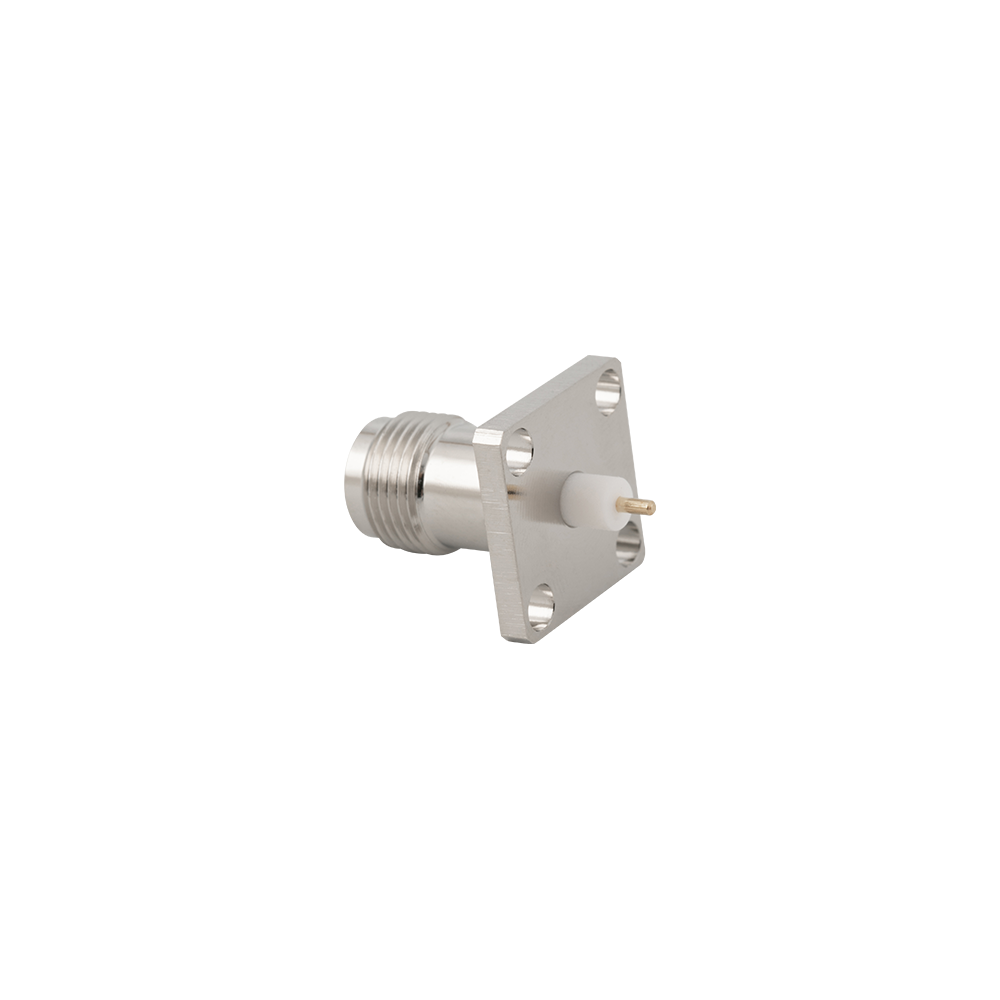
The RPTNC micro-strip connector provides a PCB-mount launch from a microstrip or coplanar waveguide trace to the reverse-polarity TNC coaxial interface, enabling direct RPTNC antenna cable connection to the PCB RF circuitry of ruggedized WLAN equipment, vehicle-mounted wireless controller boards, and industrial wireless module platforms where the vibration-resistant TNC interface is specified at the board level.

Key Features
PCB launch connector geometry providing smooth impedance transition from 50 Ω microstrip trace to RP-TNC coaxial interface
Reversed center conductor (RP-TNC) for direct mating with RPTNC cable connectors used in vehicle and ruggedized outdoor WLAN equipment
Robust PCB attachment via through-hole solder posts providing mechanical retention against TNC mating torque and cable pull forces
Low insertion loss across 2.4 GHz, 5 GHz, and 6 GHz WLAN frequencies validated on Agilent VNA instrumentation
Precision center pin height and board alignment for consistent impedance across production PCB assemblies
Compatible with standard through-hole wave-solder PCB assembly processes
Gold-plated contacts for reliable solderability and long-term contact resistance stability
RoHS-compliant

Typical Applications
Ruggedized vehicle-mounted WLAN controller and router PCB RF port
Industrial wireless gateway PCB antenna connector in high-vibration environments
Mobile command vehicle communication system PCB RF interface
Outdoor ruggedized WLAN equipment PCB direct antenna connection
Heavy-duty vehicle fleet management and telematics unit PCB WLAN antenna port
 
FAQ
Q: What is the advantage of an RPTNC micro-strip connector over using a pigtail to an RPTNC bulkhead?
A: A PCB-mount micro-strip connector eliminates the pigtail cable assembly between the PCB trace and the panel connector — removing a connection point, reducing insertion loss, and simplifying the assembly BOM; this is particularly valuable in space-constrained vehicle
mounted and ruggedized equipment designs.
Q: Can you provide S-parameter data for your RPTNC micro-strip connectors?
A: Yes — our RPTNC micro-strip connectors are characterized on Agilent VNA instrumentation and S-parameter data is available for customer system simulation; please contact our technical team to request measurement data for your frequency range of interest.


About
Yangzhou Jingcheng Electronics Co., Ltd.

Yangzhou Jingcheng Electronics Co., Ltd., a premier China RPTNC Micro-strip Connectors Manufacturer and RPTNC Micro-strip Connectors Supplier, was founded in 1999. It is a high-tech enterprise specializing in the R&D and manufacturing of RF coaxial connectors, cable assemblies, and passive microwave components.
Equipped with a comprehensive R&D and production system, the company has obtained international certifications including ISO9001. Adhering strictly to standards such as MIL, IEC and GB, we offer over 30 product series with more than 2,000 specifications, covering SMA, BNC, N-type and other mainstream models. Our products are widely applied in the fields of communications, aerospace, automotive electronics and beyond, and exported to many countries and regions across Europe, America and Asia.
We uphold the tenet of "Quality as the Foundation, Customers as the Core", committed to providing reliable interconnection solutions and professional services for global clients.

News & Updates
50 Ohm Coax Cable Explained: What It Means, Why It Matters, and How to Choose
Industry News
2026-09-11
50 Ohm Coax Cable Explained: What It Means, Why It Matters, and How to Choose
A 50 ohm coax cable is a transmission line with a characteristic impedance of 50 ohms, and it is the default choice in most RF systems because it balances low signal loss with reasonable power-handling capability. The “50 ohm” rating does...
12G BNC Connector Guide: 75-Ohm Coaxial Connectors for 4K and 8K SDI Video Systems
Industry News
2026-09-04
12G BNC Connector Guide: 75-Ohm Coaxial Connectors for 4K and 8K SDI Video Systems
A 12G BNC connector is a 75-ohm RF coaxial connector engineered to carry 12G-SDI signals up to 12 Gbps, supporting 4K and 8K video over a single cable. It is not merely a "standard BNC" with a different part number; its electrical perform...
Antenna Connector Types: SMA vs N Type vs TNC vs BNC vs RP-SMA Complete Guide
Industry News
2026-08-24
Antenna Connector Types: SMA vs N Type vs TNC vs BNC vs RP-SMA Complete Guide
Choosing an antenna connector is one of those small decisions that can make or break an RF installation. Get it right, and the system performs almost invisibly; get it wrong, and you lose signal before power even reaches the antenna. For ...
Coaxial Cable Selection Guide: Choosing Cable, Connectors, and RF Performance
Industry News
2026-08-21
Coaxial Cable Selection Guide: Choosing Cable, Connectors, and RF Performance
An RF engineer once told me that most field failures are not component failures; they are selection failures. Selecting a coaxial cable starts with three decisions: characteristic impedance, cable size, and connector family. Get these thr...
Coax Cable Comparison: RG58 vs RG59 vs RG6 vs RG11 and Connector Matching
Industry News
2026-08-14
Coax Cable Comparison: RG58 vs RG59 vs RG6 vs RG11 and Connector Matching
Choosing a coaxial cable without comparing impedance, attenuation, and connector compatibility usually ends in poor signal quality. The practical rule is short: 50 Ω cables such as RG58 are for radio equipment, test instruments, and compac...
RPTNC Micro-strip Connectors Industry knowledge

The RPTNC connector (Reverse Polarity TNC) is a variant of the threaded TNC connector in which the center contact position is reversed compared to the standard TNC connector, while the outer threaded coupling nut remains unchanged. A micro-strip connector refers to a mounting style in which the connector is attached directly onto a printed circuit board and its center contact is aligned with a microstrip transmission line on the board surface. As a manufacturer of RF coaxial connectors since 1999, Yangzhou Jingcheng Electronics Co., Ltd (JC Company) produces RPTNC connectors in micro-strip mounting configurations for board-level RF interfacing.

Reverse Polarity Design Principle

In a standard TNC connector, the plug carries the center pin and the jack carries the center socket. In an RPTNC connector, this arrangement is reversed: the RPTNC plug contains a center socket, and the RPTNC jack contains a center pin. The threaded coupling nut interface is unchanged, so an RPTNC connector can be threaded onto a standard TNC connector, but the center contacts will not engage and no signal path will be formed. This principle applies equally to micro-strip mounted versions.

What Is a Micro-strip Mounting

A micro-strip mounting connector is designed for placement at the edge of a printed circuit board, where its center contact is soldered directly to a microstrip trace on the board. The connector body typically includes a mounting flange with holes for screw or solder attachment to the board or an adjacent chassis surface, providing mechanical support in addition to the electrical connection. This mounting style is intended for a controlled transition between the coaxial connector and the planar transmission line on the board.

RPTNC vs RPSMA: General Comparison

Attribute RPTNC RPSMA
Coupling mechanism Threaded coupling nut, generally larger thread size Threaded coupling nut, smaller hex nut size
Overall connector size Larger body and mounting footprint Smaller body and mounting footprint
Environmental sealing options Commonly available with weatherproof or sealed variants for outdoor use Primarily intended for indoor or enclosed equipment use

Common Configurations

  • RPTNC plug micro-strip mount (female contact, male thread) for board-edge attachment
  • RPTNC jack micro-strip mount (male contact, female thread) for board-edge attachment
  • Straight and right-angle body styles, depending on board orientation and enclosure layout
  • Flange-mount variants with two or four mounting holes for screw attachment to the board or chassis

Typical Applications

RPTNC micro-strip connectors are used on circuit boards within RF and wireless systems that require both a reverse polarity interface and a threaded, mechanically robust coupling, including:

  • Wireless local area network (WLAN) access points and outdoor bridges
  • Base station and repeater boards requiring a secure threaded antenna connection
  • Machine-to-machine (M2M) and industrial wireless communication boards
  • Board-to-antenna interfaces in outdoor or vibration-exposed equipment

Key Technical Parameters

Parameter General Reference Range
Impedance 50 ohm
Frequency range DC to several GHz, depending on connector series and board transition design
Mating cycles Rated according to threaded coupling design, generally supporting repeated mating
Mounting process Hand solder or wave solder for the center contact, with screw attachment for the mounting flange
Contact materials Brass or beryllium copper body with gold or other plating on contact areas

Selection Considerations

When selecting an RPTNC micro-strip connector, the following factors are typically reviewed:

  • Board thickness and microstrip trace width, to align the connector center contact with the trace
  • Required plug or jack polarity based on the mating antenna or cable interface
  • Mounting flange hole pattern, to match the intended board or chassis fixing points
  • Operating frequency range and impedance matching requirement of the RF trace
  • Environmental exposure, including whether a sealed or weatherproof variant is needed

Frequently Asked Questions

What is the difference between RPTNC and standard TNC connectors?

The threaded coupling nut interface is the same, but the center contact position is reversed. This prevents an RPTNC connector from electrically mating with a standard TNC connector, even though the threads can engage.

What distinguishes a micro-strip mount from other PCB mounting styles?

A micro-strip mount is specifically aligned to a microstrip transmission line on the board surface and typically includes a mounting flange for mechanical fixing, whereas other PCB mounting styles, such as through-hole or surface mount, may not include this flange feature.

Why choose RPTNC over RPSMA for a board design?

The choice depends on the mechanical and environmental requirements of the application. RPTNC connectors generally offer a larger threaded coupling and are more commonly available in sealed variants, while RPSMA connectors offer a smaller footprint suited to compact board layouts.