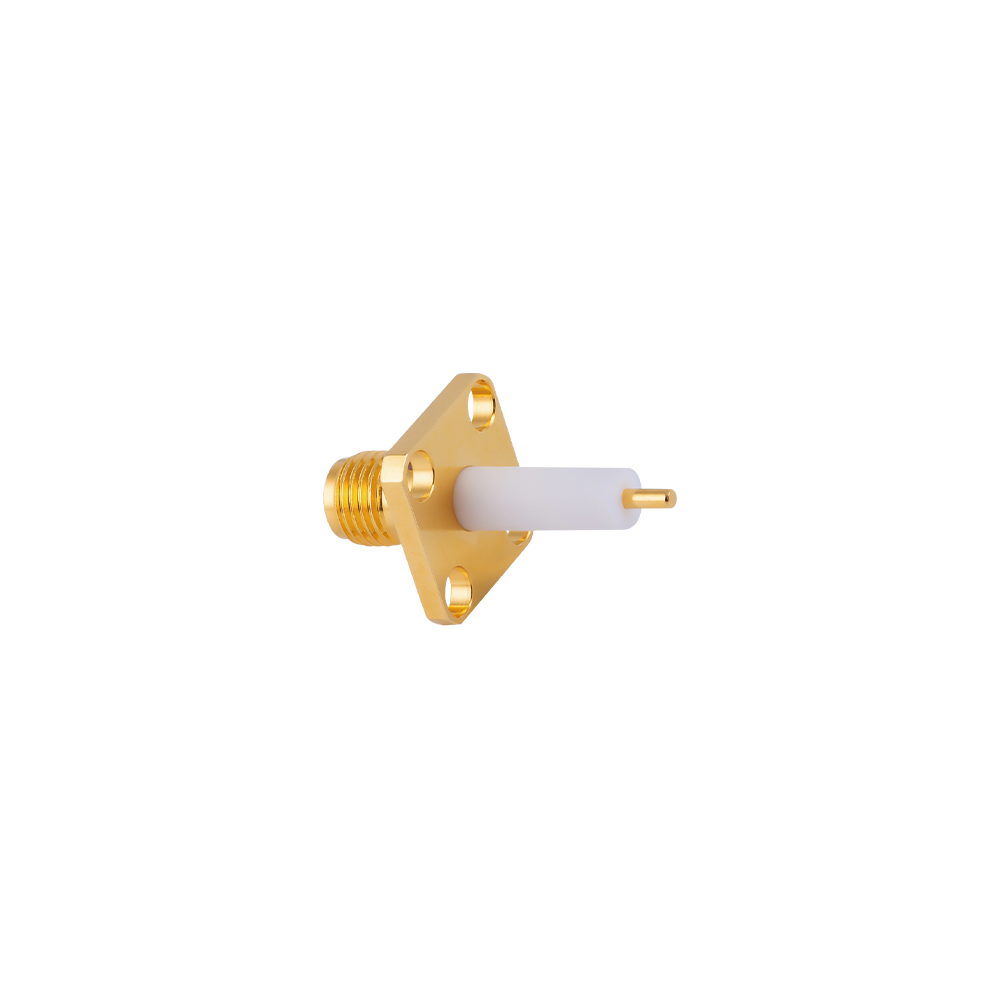
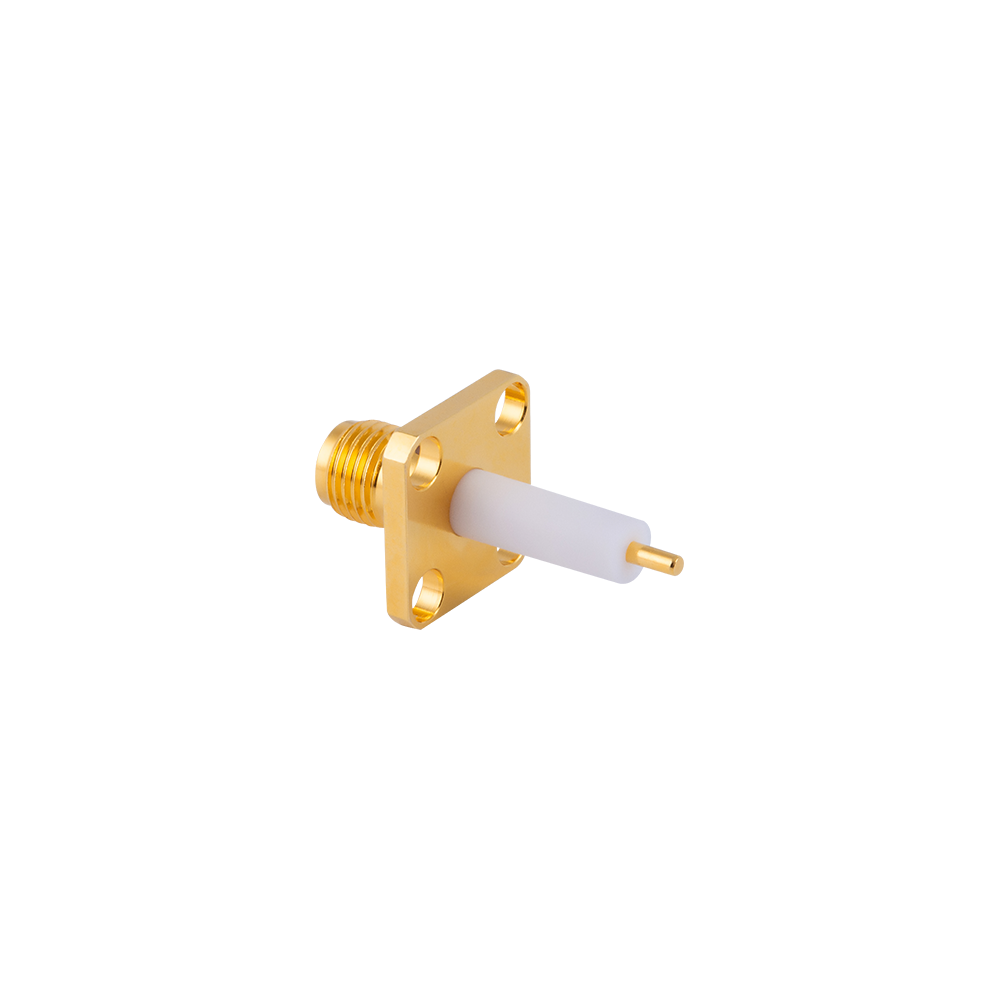
RPSMA Micro-strip Connectors Custom

Home / Products / Reverse Polarity Connectors / RPSMA Reverse Polarity Connectors / RPSMA Micro-strip Connectors

RPSMA Micro-strip Connectors Manufacturer

Product Overview
The RPSMA micro-strip connector mounts directly to a PCB edge or surface and launches the RF signal from a microstrip or coplanar waveguide trace to the RP-SMA coaxial interface, enabling direct antenna cable connection to Wi-Fi chipset evaluation boards, WLAN module development platforms, and mass-produced consumer Wi-Fi device mainboards without an intermediate pigtail or cable adapter.

Key Features
PCB edge-launch geometry optimized for low-return-loss signal transition from 50 Ω microstrip trace to RP-SMA coaxial interface
Reversed center conductor (RP) for direct mating with RPSMA cable connectors and antenna assemblies without gender adapters
Precise center pin height and PCB alignment features ensuring consistent impedance at the microstrip-to-connector transition across production boards
Low insertion loss across 2.4 GHz, 5 GHz, and 6 GHz Wi-Fi operating frequencies validated on Agilent VNA
Through-hole and SMT mounting flange options for compatibility with wave-solder and reflow PCB assembly processes
Compact PCB footprint supporting high-density Wi-Fi device mainboard and module designs
Gold-plated center contact for reliable solderability and stable contact resistance in volume PCB production
RoHS-compliant; suitable for consumer electronics and WLAN equipment OEM supply chains

Typical Applications
Wi-Fi chipset evaluation board RF output connector
Consumer Wi-Fi router and access point mainboard direct antenna interface
WLAN module development and characterization platform PCB RF port
Smart home hub and IoT gateway mainboard antenna connector
Wi-Fi 6E and Wi-Fi 7 device PCB antenna connection point
 
FAQ
Q: Do you supply a recommended PCB footprint for your RPSMA micro-strip connectors?
A: Yes — each RPSMA micro-strip connector is supplied with a recommended PCB footprint, land pattern, and soldering guidelines, and our engineering team can review your Gerber files before PCB fabrication to confirm transition geometry optimization for your substrate and trace width.
Q: What PCB substrates are your RPSMA micro-strip connectors validated on?
A: Our RPSMA micro-strip connectors are used successfully on FR4, Rogers RO4000 series, and other standard WLAN device PCB substrates; for high-frequency or low-loss substrate types, please contact our engineering team with your substrate parameters for confirmation.

About
Yangzhou Jingcheng Electronics Co., Ltd.

Yangzhou Jingcheng Electronics Co., Ltd., a premier China RPSMA Micro-strip Connectors Manufacturer and RPSMA Micro-strip Connectors Supplier, was founded in 1999. It is a high-tech enterprise specializing in the R&D and manufacturing of RF coaxial connectors, cable assemblies, and passive microwave components.
Equipped with a comprehensive R&D and production system, the company has obtained international certifications including ISO9001. Adhering strictly to standards such as MIL, IEC and GB, we offer over 30 product series with more than 2,000 specifications, covering SMA, BNC, N-type and other mainstream models. Our products are widely applied in the fields of communications, aerospace, automotive electronics and beyond, and exported to many countries and regions across Europe, America and Asia.
We uphold the tenet of "Quality as the Foundation, Customers as the Core", committed to providing reliable interconnection solutions and professional services for global clients.

News & Updates
50 Ohm Coax Cable Explained: What It Means, Why It Matters, and How to Choose
Industry News
2026-09-11
50 Ohm Coax Cable Explained: What It Means, Why It Matters, and How to Choose
A 50 ohm coax cable is a transmission line with a characteristic impedance of 50 ohms, and it is the default choice in most RF systems because it balances low signal loss with reasonable power-handling capability. The “50 ohm” rating does...
12G BNC Connector Guide: 75-Ohm Coaxial Connectors for 4K and 8K SDI Video Systems
Industry News
2026-09-04
12G BNC Connector Guide: 75-Ohm Coaxial Connectors for 4K and 8K SDI Video Systems
A 12G BNC connector is a 75-ohm RF coaxial connector engineered to carry 12G-SDI signals up to 12 Gbps, supporting 4K and 8K video over a single cable. It is not merely a "standard BNC" with a different part number; its electrical perform...
Antenna Connector Types: SMA vs N Type vs TNC vs BNC vs RP-SMA Complete Guide
Industry News
2026-08-24
Antenna Connector Types: SMA vs N Type vs TNC vs BNC vs RP-SMA Complete Guide
Choosing an antenna connector is one of those small decisions that can make or break an RF installation. Get it right, and the system performs almost invisibly; get it wrong, and you lose signal before power even reaches the antenna. For ...
Coaxial Cable Selection Guide: Choosing Cable, Connectors, and RF Performance
Industry News
2026-08-21
Coaxial Cable Selection Guide: Choosing Cable, Connectors, and RF Performance
An RF engineer once told me that most field failures are not component failures; they are selection failures. Selecting a coaxial cable starts with three decisions: characteristic impedance, cable size, and connector family. Get these thr...
Coax Cable Comparison: RG58 vs RG59 vs RG6 vs RG11 and Connector Matching
Industry News
2026-08-14
Coax Cable Comparison: RG58 vs RG59 vs RG6 vs RG11 and Connector Matching
Choosing a coaxial cable without comparing impedance, attenuation, and connector compatibility usually ends in poor signal quality. The practical rule is short: 50 Ω cables such as RG58 are for radio equipment, test instruments, and compac...
RPSMA Micro-strip Connectors Industry knowledge

At Yangzhou Jingcheng Electronics Co., Ltd., RF coaxial connectors have been part of our core product scope since 1999, and the RPSMA (Reverse Polarity SMA) micro-strip series is one of the variants we design and manufacture within our broader Reverse Polarity Connectors line. This article outlines the technical concepts, structural types, applications, and comparative characteristics of RPSMA micro-strip connectors as commonly understood in the RF connector industry.

1. What Is an RPSMA Micro-strip Connector

An RPSMA connector is a modified version of the standard SMA (SubMiniature version A) coaxial connector, in which the gender of the interface pin and socket is reversed relative to the threaded coupling gender. This means a female-threaded RPSMA connector carries a center pin, while a male-threaded RPSMA connector carries a center socket. This reversal was originally introduced to comply with regulatory requirements that prevent standard SMA antennas from being mistakenly connected to certain unlicensed wireless devices.

The term micro-strip refers to a connector configuration designed for direct mounting onto a printed circuit board (PCB) micro-strip transmission line, rather than being terminated onto a coaxial cable. The connector body typically includes a flange or through-hole mounting structure with a protruding center contact (pin or socket tail) that is soldered directly to the PCB signal trace and ground plane.

2. Structural Types

RPSMA micro-strip connectors are generally categorized by mounting style and contact gender:

  • Edge-mount (End-launch) type: mounted at the edge of the PCB, with the connector axis aligned with the board plane, commonly used where the connector needs to sit flush with the board edge.
  • Vertical (Right-angle or Top-mount) type: mounted perpendicular to the PCB surface, used when the connector must exit vertically from the board, such as in enclosures with side-panel connector openings.
  • Flange type: includes two or four mounting holes for screw fixation, offering greater mechanical stability against connector torque and vibration.
  • Non-flange (compact) type: relies on solder tabs only, without screw holes, used where board space is limited.

3. Key Technical Parameters

Parameter Typical Range / Description
Impedance 50 Ohm (nominal)
Frequency Range DC up to approximately 6 GHz for standard SMA-based interfaces
Coupling Mechanism Threaded coupling nut (5/16-inch, 32 UNEF thread, per SMA standard)
Mounting Method Direct PCB solder mounting (through-hole or surface mount)
Contact Gender Arrangement Reversed relative to standard SMA (pin/socket swapped)
Common Materials Brass or beryllium copper body with gold or nickel plating; PTFE dielectric

4. Typical Applications

RPSMA micro-strip connectors are widely used in scenarios requiring a direct board-to-antenna or board-to-cable RF interface, including:

  • Wireless routers and gateways, where the connector links the main PCB to an external antenna.
  • Wi-Fi and WLAN modules requiring compliance with reverse-polarity regulations for consumer wireless equipment.
  • IoT and M2M devices with compact board space and external antenna requirements.
  • GPS and telematics modules used in transportation and industrial control systems.
  • Network communication equipment, including modems and small-cell base station boards.

Within our own product range, similar reverse polarity and micro-strip configurations are supplied alongside our broader SMA, SMZ, MCX, and MMCX series, and are typically applied across the communications, network systems, and industrial electronics fields referenced in our product documentation.

5. RPSMA vs. Standard SMA: Comparison

Aspect Standard SMA RPSMA
Pin/Socket Arrangement Matches thread gender (male has pin, female has socket) Reversed (male has socket, female has pin)
Interchangeability Not directly compatible with RPSMA Not directly compatible with standard SMA
Typical Use Case General RF and test equipment Consumer wireless devices under regulatory reverse-polarity requirements
Electrical Performance Comparable to RPSMA when built to equivalent specifications Comparable to standard SMA when built to equivalent specifications

6. Manufacturing and Quality Considerations

Producing RPSMA micro-strip connectors requires precision in the machining of the reversed center contact and in the plating process, since inconsistent pin protrusion or socket depth can affect mating reliability and signal integrity. As a manufacturer holding ISO9001 certification and applying MIL, IEC, and GB standards across our RF connector production, we place emphasis on dimensional consistency, plating quality, and impedance control during design and production of connectors in this category.

7. Frequently Asked Questions

Can an RPSMA connector mate with a standard SMA connector?

No. Because the pin and socket positions are reversed, an RPSMA connector cannot mate with a standard SMA connector of the same thread gender without an adapter.

What distinguishes a micro-strip type from a cable-mount type?

A micro-strip type is designed for direct PCB solder mounting, while a cable-mount type is designed to be crimped or soldered onto a coaxial cable assembly.

Is the frequency performance of RPSMA lower than standard SMA?

Not inherently. Frequency performance depends on the mechanical design, dielectric material, and manufacturing precision rather than the reverse-polarity feature itself.

Summary

RPSMA micro-strip connectors serve a specific regulatory and functional purpose within the broader RF connector ecosystem, combining reverse-polarity contact design with direct board-mount convenience. As part of our Reverse Polarity Connectors and Coaxial Connectors product categories, we continue to design and manufacture these components in accordance with recognized industry standards.