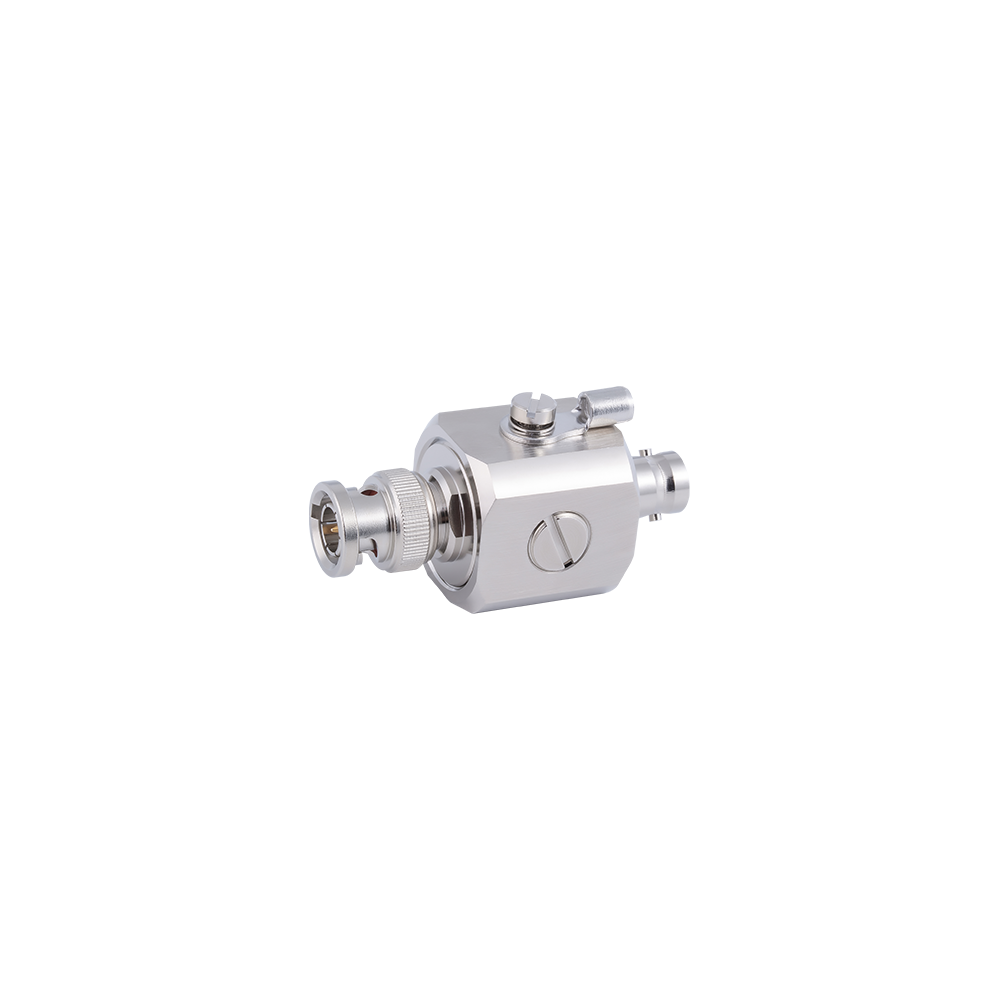
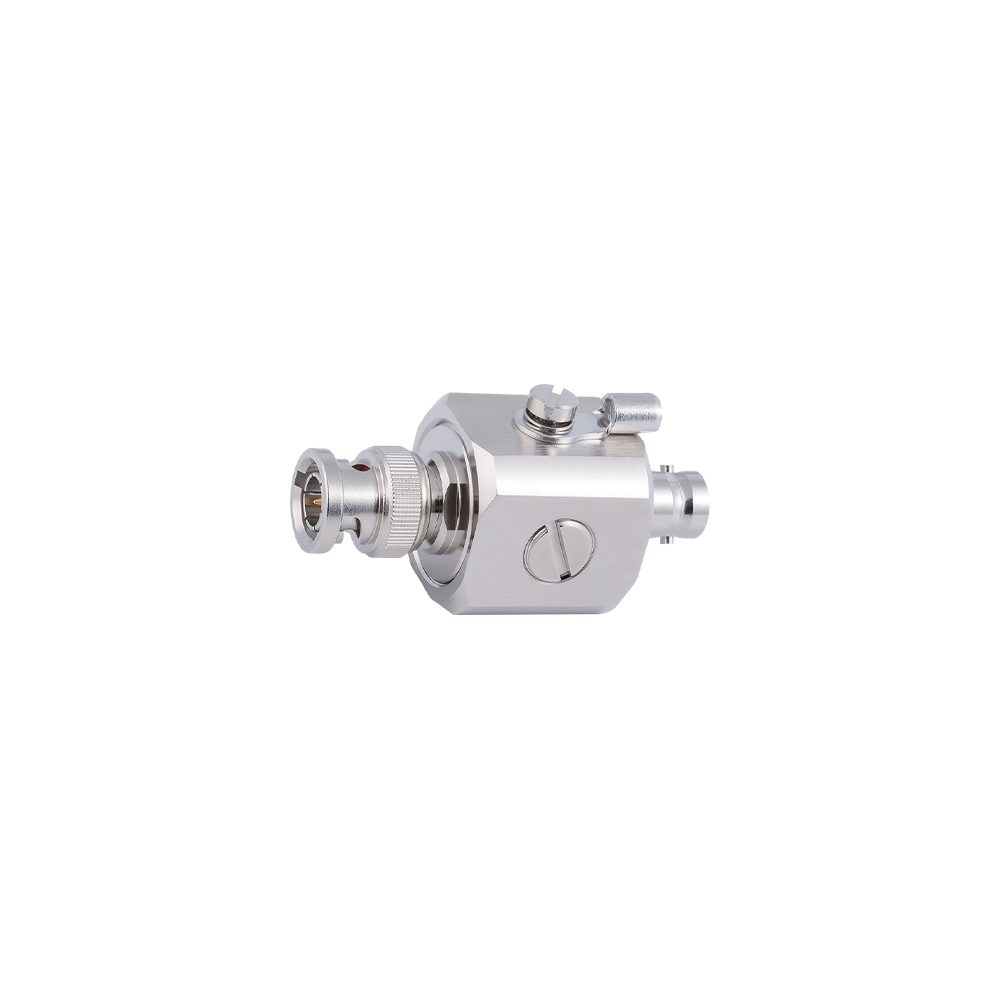
Product Overview The BNC Coaxial Lightning Protector from Yangzhou Jingcheng Electronics delivers reliable transient overvoltage protection at the BNC interface, making it the ideal front-line defense for CCTV backbones, broadcast video distribution frames, test-and-measurement instrument inputs, and low-power RF antenna feeds. The quarter-turn bayonet locking mechanism enables rapid field installation without tools, while the integrated gas-discharge or transient-voltage suppressor (TVS) element ensures fast clamping response to protect sensitive baseband and RF electronics from induced lightning energy.
Key Features BNC male-to-female inline configuration for drop-in installation on existing cabling Choice of GDT or TVS protection topology to match impedance-sensitive or fast-response application requirements 50 Ω system impedance with matched characteristic impedance to minimise reflections in precision RF paths Operating frequency range from DC to 4 GHz covering baseband video through S-band RF Compact, lightweight aluminium-alloy body suitable for rack-frame, bulkhead, and panel-mount use Nickel-plated brass or stainless steel outer contact for long service life in indoor and light-outdoor environments Low clamping voltage to protect sensitive semiconductor inputs in test instruments and SDI video equipment RoHS-compliant construction throughout
Typical Applications CCTV and IP-camera coaxial backbone protection at distribution frames Broadcast SDI video router and patch panel surge protection Test-and-measurement instrument RF input protection in outdoor or field-deployed scenarios Low-power antenna feeds for weather stations, telemetry, and IoT gateway devices Amateur radio station antenna connection points
FAQ Q: Does the BNC protector affect video signal quality on HD-SDI or analog CCTV? A: The GDT variant is optimised for minimal capacitive loading; for HD-SDI and 3G-SDI applications please specify the low-capacitance version to maintain signal integrity. Q: What is the typical insertion loss at 1 GHz? A: Contact our technical team for measured insertion loss data for each variant, as values depend on protection topology and operating frequency. Q: Can it be used outdoors? A: The standard version is rated for indoor and sheltered outdoor use; a weather-sealed version with O-ring sealing is available for fully exposed installations. Q: Do you offer a BNC-to-N adapter version for legacy system upgrades? A: Hybrid adapter-protector combinations can be custom-engineered; please contact sales with your interface requirements.
Yangzhou Jingcheng Electronics Co., Ltd., a premier China BNC Coaxial Lightning Protector Manufacturer and BNC Coaxial Lightning Protector Factory, was founded in 1999. It is a high-tech enterprise specializing in the R&D and manufacturing of RF coaxial connectors, cable assemblies, and passive microwave components.
Equipped with a comprehensive R&D and production system, the company has obtained international certifications including ISO9001. Adhering strictly to standards such as MIL, IEC and GB, we offer over 30 product series with more than 2,000 specifications, covering SMA, BNC, N-type and other mainstream models. Our products are widely applied in the fields of communications, aerospace, automotive electronics and beyond, and exported to many countries and regions across Europe, America and Asia.
We uphold the tenet of "Quality as the Foundation, Customers as the Core", committed to providing reliable interconnection solutions and professional services for global clients.
BNC Coaxial Lightning Protector Industry knowledge
1. What Is A BNC Coaxial Lightning Protector
A BNC Coaxial Lightning Protector is an inline surge protection component built around the BNC bayonet interface, designed to divert transient overvoltage away from connected baseband and RF electronics before it reaches sensitive equipment. Positioned between a coaxial cable run and the connected device, a BNC Coaxial Lightning Protector allows normal signal transmission to continue with minimal impact while providing a fast clamping response the moment induced surge energy exceeds safe operating levels. Because the BNC interface uses a quarter-turn bayonet locking mechanism, a BNC Coaxial Lightning Protector can generally be installed in the field without special tools, which makes it a practical addition to existing CCTV backbones, broadcast video distribution frames, test-and-measurement instrument inputs, and low-power RF antenna feeds. This article covers the working principle, common protection topologies, application scenarios, comparative performance factors, and maintenance guidance relevant to this protector category.
2. Working Principle: GDT And TVS Protection Topologies
A gas-discharge tube, or GDT, protection element remains electrically inactive under normal operating voltage and ionizes rapidly once surge voltage crosses a defined threshold, opening a low-impedance path to ground and offering low capacitive loading that suits precision RF paths. A transient-voltage suppressor, or TVS, element instead relies on a semiconductor junction that begins conducting almost instantly as voltage rises, offering a very fast clamping response suited to protecting sensitive semiconductor inputs found in test instruments and SDI video equipment. Both topologies are built around a 50 ohm system impedance in this protector line, matching the characteristic impedance of the connected cabling to minimize reflections along the RF path. The unit's operating frequency range extends from DC to 4 GHz, covering baseband video signals through S-band RF, which allows a single BNC Coaxial Lightning Protector design to serve both video distribution and RF antenna feed applications.
3. Common Types And Features
(1) Gas-Discharge Tube Variant
This variant offers low capacitive loading and is generally specified for precision RF paths and impedance-sensitive antenna feed applications.
(2) Transient-Voltage Suppressor Variant
This variant provides a very fast clamping response and is generally specified where sensitive semiconductor inputs, such as test instrument or SDI video equipment inputs, need rapid protection.
(3) Weather-Sealed Outdoor Variant
Fitted with O-ring sealing, this variant extends use to fully exposed outdoor installations beyond the indoor and sheltered outdoor rating of the standard version.
4. Comparing GDT And TVS Protection Topologies
The table below summarizes the core differences between the GDT and TVS protection topologies available within the BNC Coaxial Lightning Protector line.
Comparison between GDT and TVS protection topologies
Attribute
GDT Topology
TVS Topology
Capacitive loading
Very low
Moderate
Response speed
Fast, ionization-based
Very fast, semiconductor-based
Best suited for
Precision RF and antenna feeds
Sensitive semiconductor inputs
Typical application
RF antenna feeds, IoT telemetry
SDI video, test instruments
5. Application Suitability By Topology: A Heatmap View
Before viewing the heatmap below, it is useful to understand what it represents. The BNC Coaxial Lightning Protector line serves several distinct application categories, including CCTV and IP-camera backbones, broadcast SDI video routing, test-and-measurement instrument inputs, low-power antenna feeds for telemetry and IoT gateways, and amateur radio antenna connections. Each of these applications tends to favor either the GDT or TVS topology described earlier, depending on whether impedance precision or semiconductor input protection is the higher priority. The heatmap below uses color intensity to represent relative topology suitability across these five application categories, rather than presenting measured test data.
In this heatmap, darker red cells represent higher relative suitability for that topology within a given application, while lighter cells represent lower relative suitability. The telemetry, IoT gateway, and amateur radio antenna rows show their darkest cell under the GDT column, reflecting the low capacitive loading that these RF-sensitive antenna feed applications generally favor. The SDI video routing and test instrument rows show their darkest cell under the TVS column, consistent with the very fast, semiconductor-based clamping response that protects sensitive baseband and instrument inputs from rapid voltage transients. The CCTV backbone row shows a more moderate preference toward TVS, reflecting the mix of baseband video and camera control signals typically carried on this type of backbone. This pattern illustrates why the BNC Coaxial Lightning Protector line offers both GDT and TVS variants rather than a single fixed topology, since no single approach optimally serves every application category represented in this heatmap. Buyers selecting between these topologies should weigh the specific signal type, the frequency content of the protected system, and whether capacitive loading or clamping speed is the more critical performance factor for a given installation. As with other visuals in this article, the specific suitability levels shown here are illustrative and intended to convey general engineering guidance rather than measured laboratory results.
6. Clamping Voltage Comparison Across Topologies
Before viewing the horizontal bar chart below, it helps to understand what clamping voltage represents and why it matters for equipment protection. Clamping voltage refers to the residual voltage that still reaches downstream equipment after the protection element has activated, and a lower clamping voltage generally means better protection for sensitive semiconductor inputs. The chart below compares an illustrative relative clamping voltage range for the GDT and TVS topologies described earlier in this article, alongside an unprotected reference point for context.
The unprotected reference bar in this chart is drawn at full length, representing the surge voltage that would reach downstream equipment with no protection element in place at all. The GDT protected bar is meaningfully shorter, reflecting the reduced residual voltage once the gas-discharge tube ionizes and begins conducting surge current to ground. The TVS protected bar is shorter still, reflecting the very fast, semiconductor-based clamping response that limits residual voltage more tightly than the GDT topology in this illustrative comparison. This pattern is consistent with the general engineering distinction described earlier, where TVS elements are typically favored for protecting the most voltage-sensitive semiconductor inputs, while GDT elements are favored where low capacitive loading matters more than achieving the absolute lowest clamping voltage. For CCTV backbones and broadcast SDI routing, where downstream equipment often includes sensitive semiconductor input stages, a lower clamping voltage generally translates into a wider protective margin against equipment damage during a surge event. For RF antenna feed applications where impedance precision is the priority, the GDT topology's lower capacitive loading is often considered the more important factor, even though its clamping voltage is comparatively higher than the TVS topology shown here. As with the heatmap above, the specific values in this chart are illustrative and intended to demonstrate the general relationship between topology choice and clamping performance rather than measured test data for a specific part number.
7. Maintenance Guidance
Confirm the bayonet locking mechanism is fully seated after installation to maintain a secure, low-resistance connection.
For outdoor installations, confirm whether the weather-sealed variant with O-ring sealing is required for the exposure level at that site.
After a known significant surge event, inspect or test the unit to confirm it remains within normal operating parameters.
Inspect the nickel-plated brass or stainless steel outer contact periodically for corrosion, particularly in humid environments.
Keep installation and inspection records to support planned maintenance intervals across distribution frames and antenna feed points.
8. Manufacturing Background
Yangzhou Jingcheng Electronics Co., Ltd., founded in 1999, specializes in the research, development, and manufacturing of RF coaxial connectors, cable assemblies, and passive microwave components, including the BNC Coaxial Lightning Protector across GDT, TVS, and weather-sealed configurations. Operating under ISO9001 certification and in line with standards such as MIL, IEC, and GB, the company offers a broad product range applied across communications, aerospace, and automotive electronics fields, with distribution across multiple regions internationally, supporting RoHS-compliant construction across its coaxial protection accessories.
9. Frequently Asked Questions
Q1: Does a BNC Coaxial Lightning Protector affect video signal quality on HD-SDI or analog CCTV?
The GDT variant is optimized for minimal capacitive loading; for HD-SDI and 3G-SDI applications, a low-capacitance version helps maintain signal integrity.
Q2: What operating frequency range does this protector cover?
The unit generally covers DC to 4 GHz, spanning baseband video signals through S-band RF applications.
Q3: Can it be used outdoors?
The standard version is rated for indoor and sheltered outdoor use, while a weather-sealed version with O-ring sealing is available for fully exposed installations.
Q4: Is a BNC-to-N hybrid adapter-protector version available for legacy upgrades?
Hybrid adapter-protector combinations can be custom-engineered based on the specific interface requirements of a legacy system upgrade.


 English
 中文简体
中文简体