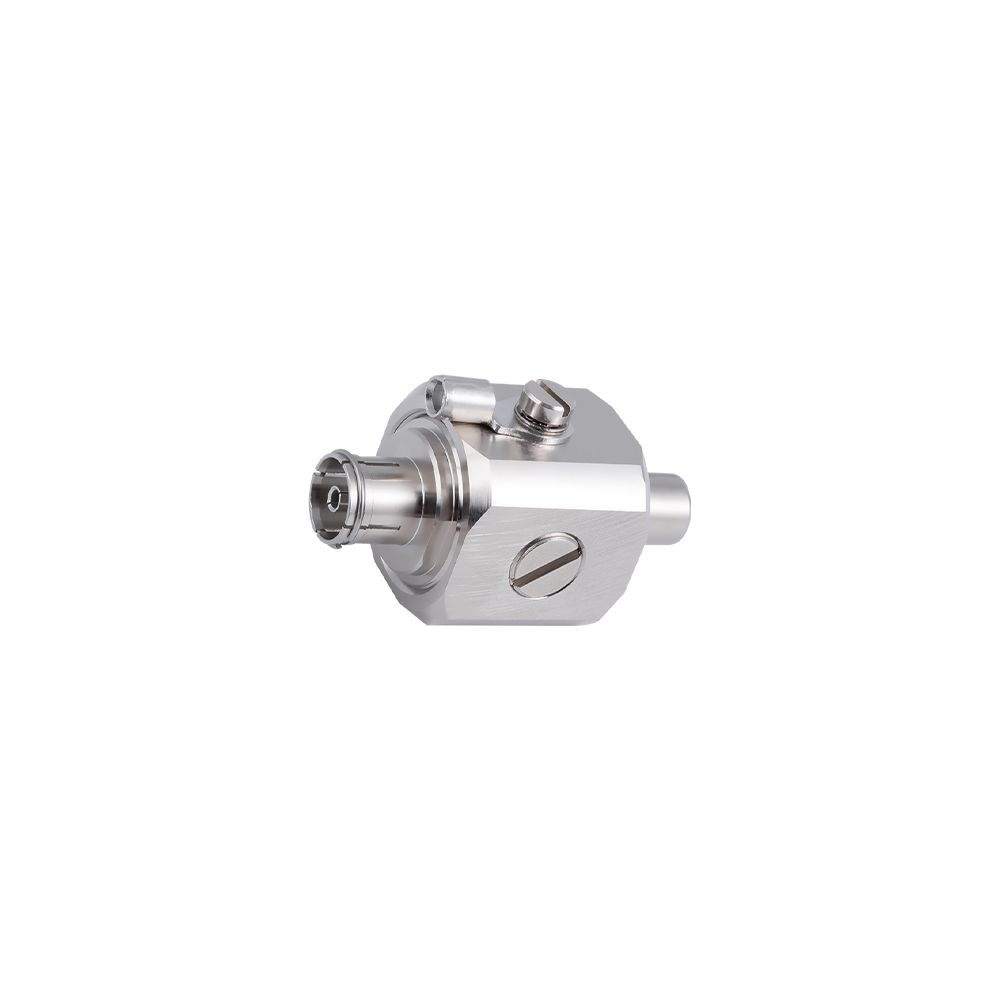
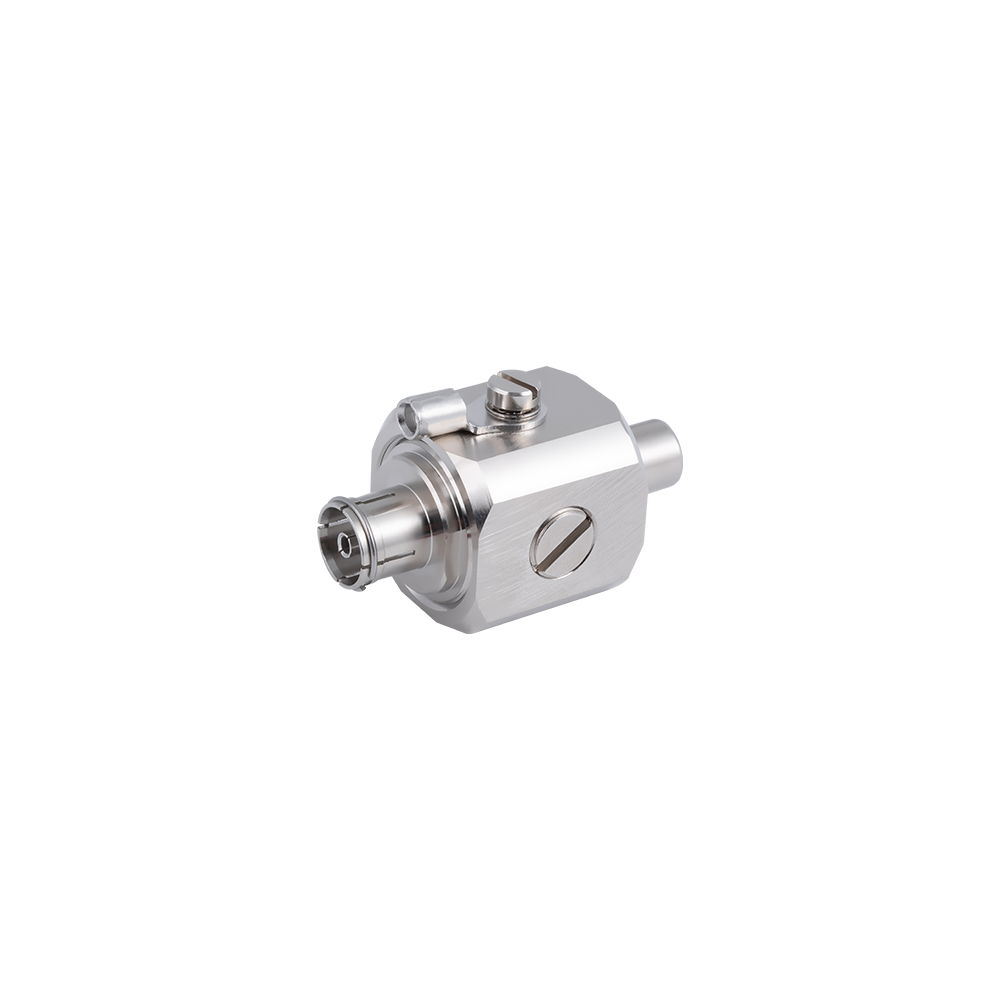
Product Overview This TAC coaxial lightning surge protector is engineered for TAC series coaxial interfaces deployed in mobile vehicle communication systems and transportable field communication equipment. The protector maintains the structural integrity and locking mechanism of the standard TAC interface while integrating surge immunity. It prevents high-energy electrical surges, induced by lightning strikes on vehicle-mounted or manpack antenna systems, from reaching and damaging sensitive transceiver front-end circuits.
Key Features TAC interface inline protector maintaining the ruggedised mechanical retention characteristics of the TAC connector series Protection frequency range covering HF through UHF tactical communication bands Compact low-profile design to fit within constrained vehicle radio rack and portable equipment installations Military-grade materials and surface treatment for resistance to vibration, shock, salt-fog, and humidity per MIL-STD-810 Quick-connect coupling mechanism preservation for rapid antenna change-out in tactical scenarios Grounding provision compatible with vehicle chassis bonding requirement
Typical Applications Vehicle-mounted tactical radio antenna connection surge protection Man-pack military radio portable antenna feed protection Tactical satellite communication terminal antenna interface Military vehicle integration for HF/VHF/UHF antenna systems
FAQ Q: Is the TAC protector qualified to MIL-STD-810 environmental requirements? A: The unit is designed to MIL-STD-810 environmental principles; formal qualification testing documentation is available for defence procurement programs upon request. Q: Does it maintain the quick-connect speed of the TAC interface for field use? A: Yes, the protector preserves the TAC coupling mechanism to ensure rapid antenna connection and disconnection in field operations. Q: What frequency range does it cover for tactical HF/VHF/UHF communications? A: Frequency coverage spans the tactical HF through UHF spectrum; specific band coverage details are provided on the product datasheet. Q: Can you supply this as part of a complete tactical antenna cable assembly? A: Yes, complete cable assemblies with TAC protectors integrated are available as custom OEM solutions; contact our defence sales team.
Yangzhou Jingcheng Electronics Co., Ltd., a premier China TAC Coaxial Lightning Protector Manufacturer and TAC Coaxial Lightning Protector Factory, was founded in 1999. It is a high-tech enterprise specializing in the R&D and manufacturing of RF coaxial connectors, cable assemblies, and passive microwave components.
Equipped with a comprehensive R&D and production system, the company has obtained international certifications including ISO9001. Adhering strictly to standards such as MIL, IEC and GB, we offer over 30 product series with more than 2,000 specifications, covering SMA, BNC, N-type and other mainstream models. Our products are widely applied in the fields of communications, aerospace, automotive electronics and beyond, and exported to many countries and regions across Europe, America and Asia.
We uphold the tenet of "Quality as the Foundation, Customers as the Core", committed to providing reliable interconnection solutions and professional services for global clients.
TAC Coaxial Lightning Protector Industry knowledge
1. TAC Coaxial Lightning Protector Overview
The TAC Coaxial Lightning Protector is a surge protective device engineered specifically for the TAC (Tactical) series coaxial interface—a ruggedized connector standard widely deployed in mobile vehicle communication systems, manpack tactical radios, and transportable field communication equipment. This inline protector integrates surge immunity while preserving the structural integrity and quick-connect locking mechanism of the TAC interface, preventing high-energy electrical surges from reaching and damaging sensitive transceiver front-end circuits.
Yangzhou Jingcheng Electronics Co., Ltd., established in 1999, manufactures TAC Coaxial Lightning Protectors that comply with the dimensional and performance requirements of MIL-DTL-55116—the military specification governing TAC connectors[reference:0][reference:1]. With over 30 product series and more than 2,000 specifications covering SMA, BNC, N-type, and TAC configurations, the company delivers reliable interconnection solutions for defense communications, aerospace, and tactical radio applications worldwide. Each TAC Coaxial Lightning Protector is designed to maintain the 50Ω characteristic impedance required for HF through UHF tactical communication bands.
The TAC interface is characterized by its compact form factor—approximately half the size of standard M55116 connectors[reference:2][reference:3]—while maintaining the same performance benefits. The TAC Coaxial Lightning Protector preserves this quick-connect coupling mechanism, enabling rapid antenna change-out in tactical scenarios where operational tempo is critical. Constructed with military-grade materials and surface treatments, these protectors are designed to withstand vibration, shock, salt-fog, and humidity per MIL-STD-810 environmental requirements[reference:4].
Core Attributes of TAC Coaxial Lightning Protector:
HF through UHF tactical communication band coverage
GDT-based surge protection with up to 20 kA (8/20 μs) discharge capacity
Low insertion loss and VSWR across the tactical frequency spectrum
Preservation of TAC quick-connect coupling mechanism for field operations
Compliance with MIL-DTL-55116 interface and MIL-STD-810 environmental requirements
2. Working Principle and Protection Technologies
The TAC Coaxial Lightning Protector operates on the principle of transient voltage suppression using gas discharge tube (GDT) technology. Under normal operating conditions, the device remains transparent to RF signals, allowing unimpeded transmission through the 50Ω coaxial path. When a surge voltage exceeds the protection threshold—typically between 90V and 470V depending on the model—the GDT ionizes and creates a low-impedance path to ground, redirecting the surge current away from the protected tactical radio equipment.
(1) Gas Discharge Tube (GDT) Technology
GDT-based TAC Coaxial Lightning Protectors utilize a sealed gas-filled chamber that ionizes when a voltage surge exceeds the spark-over threshold. Once ionized, the gas becomes conductive, creating a momentary short circuit that diverts surge current to ground. This technology offers wide bandwidth capability covering HF through UHF tactical communication bands, DC pass-through functionality for remote antenna system powering, and a compact form factor suitable for constrained vehicle radio rack and portable equipment installations.
(2) Hybrid Protection Technology
Hybrid TAC Coaxial Lightning Protectors combine GDT primary protection with a secondary stage—such as transient voltage suppression (TVS) diodes or metal oxide varistors (MOVs)—to achieve faster response times and lower let-through voltages. These multi-stage designs provide enhanced protection for sensitive tactical receiver front-ends, where even moderate residual voltages can cause damage or degradation to mission-critical communication equipment.
(3) Quarter-Wave Stub Technology
Quarter-wave stub protectors function as a frequency-selective filter, tuned to a quarter-wavelength of the operating frequency. This technology is maintenance-free and exhibits low intermodulation distortion but is inherently narrowband and does not pass DC signals. In tactical communication applications, this limitation makes quarter-wave protectors less suitable for systems requiring DC power injection over the coaxial line, such as powering mast-top amplifiers or antenna-mounted electronics.
The radar chart above illustrates the comparative performance of three primary protection technologies used in TAC Coaxial Lightning Protectors for tactical communication applications. Gas Discharge Tube (GDT) technology offers wide bandwidth and DC pass capability but requires periodic maintenance and exhibits moderate residual voltage. Hybrid technology combines GDT with TVS diodes, providing faster response times and lower residual voltage while maintaining wide bandwidth and DC pass capability—making it particularly suitable for protecting sensitive tactical receiver front-ends. Quarter-wave stub technology is maintenance-free with low residual voltage but lacks DC pass capability and is inherently narrowband, limiting its use in broadband tactical communication systems. For most tactical HF/VHF/UHF applications, GDT-based TAC Coaxial Lightning Protectors offer the best balance of performance and field reliability. Hybrid versions are recommended for protecting highly sensitive receiver chains where noise figure preservation is critical. Quarter-wave types are generally not used in TAC tactical applications due to their narrowband limitation. Yangzhou Jingcheng Electronics manufactures both GDT and hybrid variants, enabling defense system engineers to select the optimal protection for their specific tactical communication requirements.
3. TAC Interface Standards and MIL-DTL-55116 Compliance
The TAC interface is defined by MIL-DTL-55116, a military specification for miniature coaxial connectors used in tactical communication systems[reference:5][reference:6]. TAC Coaxial Lightning Protectors must conform to these standards to ensure proper mating and consistent RF performance across different manufacturers' tactical radio equipment.
Table 1: TAC Connector Standards and Specifications
Standard
Description
Key Requirements
MIL-DTL-55116
Miniature coaxial connectors for tactical applications
50Ω impedance, quick-connect coupling, compact form factor
MIL-STD-810
Environmental engineering considerations and laboratory tests
Vibration, shock, salt-fog, humidity, temperature extremes
MIL-STD-461
Electromagnetic interference (EMI) control
EMI/RFI shielding effectiveness
IEC 61643-21
Surge protective devices connected to telecom networks
Surge current rating, clamping voltage, response time
Yangzhou Jingcheng Electronics manufactures TAC Coaxial Lightning Protectors in full compliance with these standards, ensuring interoperability with all TAC-equipped tactical radio equipment. The TAC connector's compact form factor—approximately half the size of standard M55116 connectors[reference:7]—makes it particularly suitable for space-constrained vehicle and manpack radio installations, while the quick-connect coupling mechanism enables rapid antenna change-out in tactical scenarios[reference:8].
4. Frequency Response and Insertion Loss Performance
The electrical performance of a TAC Coaxial Lightning Protector is critical for maintaining signal integrity in tactical communication systems. Insertion loss and return loss (VSWR) directly affect communication range, signal clarity, and overall link performance. The following chart shows typical insertion loss behavior across the HF through UHF tactical communication spectrum.
The line chart above compares insertion loss for GDT-based and hybrid TAC Coaxial Lightning Protectors across the tactical frequency spectrum from HF through UHF. The GDT-based protector exhibits a flat insertion loss below 0.10 dB from HF through VHF, rising gradually to approximately 0.15 dB at UHF frequencies and reaching approximately 0.18 dB at 2 GHz. The hybrid version shows slightly higher loss due to the added capacitance of the TVS diode, maintaining values under 0.12 dB through VHF and reaching approximately 0.20 dB at 2 GHz. These low loss values ensure that tactical communication range is preserved and that transmitted power reaches the antenna with minimal attenuation—a critical factor in field operations where link margins are often limited. The VSWR for both variants remains below 1.25:1 across the entire tactical frequency spectrum, minimizing signal reflections that could degrade voice and data communications. The frequency response characteristics are verified through 100% testing on network analyzers before shipment. Yangzhou Jingcheng Electronics provides measured data for each production lot to support system-level performance verification. For applications requiring operation above 2 GHz, extended-frequency versions are available upon request.
5. Key Performance Specifications
The performance of a TAC Coaxial Lightning Protector is defined by several critical electrical and mechanical parameters that directly impact system reliability and communication effectiveness in tactical environments.
The horizontal bar chart above presents the typical performance range for TAC Coaxial Lightning Protectors. Insertion loss values below 0.20 dB ensure that signal attenuation remains negligible, preserving communication range and clarity in tactical operations. VSWR values below 1.25:1 indicate excellent impedance matching, minimizing signal reflections that could degrade voice and data communications in the field. Maximum discharge current ratings from 5 kA to 20 kA (8/20 μs waveform) provide robust protection against lightning-induced surges that may couple into vehicle-mounted or manpack antenna systems. The wide operating temperature range of -40°C to +90°C ensures reliable operation in diverse environmental conditions—from arctic cold to desert heat—as required by MIL-STD-810[reference:9]. Impulse life ratings of 400 surges at 500 A demonstrate the durability and long-term reliability of these protection devices in field-deployed tactical communication systems. The DC pass-through capability enables remote powering of mast-top amplifiers and antenna-mounted electronics without additional bias tees.
6. Application Scenarios
TAC Coaxial Lightning Protectors are deployed across a range of tactical communication applications where the TAC interface is used. The device is typically installed at the antenna port or radio interface to provide localized surge protection in field environments.
(1) Vehicle-Mounted Tactical Radios
In military vehicle communication systems, TAC Coaxial Lightning Protectors protect transceivers from surges that may couple into vehicle-mounted antenna systems during lightning storms. The compact form factor is suitable for constrained vehicle radio rack installations[reference:10].
(2) Manpack Military Radios
Portable tactical radios used by dismounted soldiers benefit from the lightweight, compact design of the TAC Coaxial Lightning Protector, which adds minimal weight and bulk while providing essential surge protection for the radio's antenna port.
(3) Tactical Satellite Communication Terminals
Tactical SATCOM terminals utilize TAC Coaxial Lightning Protectors to safeguard RF inputs from lightning-induced transients, ensuring continuous communication capability in deployed operations.
(4) HF/VHF/UHF Antenna Systems
Military antenna systems operating across HF, VHF, and UHF bands[reference:11] employ TAC Coaxial Lightning Protectors to protect both transmit and receive paths from surge events, maintaining operational readiness in all weather conditions.
The bar chart above illustrates the estimated application distribution of TAC Coaxial Lightning Protectors across major tactical communication applications. Vehicle-mounted tactical radios represent the largest segment at 32%, driven by the widespread deployment of TAC interfaces in military vehicle communication systems. Manpack military radios account for 28% of deployments, reflecting the importance of portable communication equipment in dismounted operations. Tactical SATCOM terminals represent 22%, with HF/VHF/UHF antenna systems comprising the remaining 18%. This distribution reflects the versatility of the TAC interface across the full spectrum of tactical communication equipment. Yangzhou Jingcheng Electronics serves all these applications with tailored product solutions that meet the specific requirements of each deployment scenario. The company's extensive experience in MIL-DTL-55116 compliant manufacturing ensures that defense customers receive products that meet stringent reliability and performance standards for field operations.
7. Selection Guide and Installation Considerations
Selecting the appropriate TAC Coaxial Lightning Protector requires careful evaluation of several system parameters and installation factors specific to tactical communication environments.
(1) Frequency Range and Bandwidth
The protector's operating frequency range must encompass all tactical communication bands used by the system. Most TAC Coaxial Lightning Protectors offer coverage from HF through UHF (up to 2 GHz), accommodating the majority of tactical radio applications[reference:12].
(2) Surge Current Rating
Select a protector with a maximum discharge current rating that exceeds the anticipated surge exposure. For vehicle-mounted and manpack tactical systems, a rating of 10 kA to 20 kA (8/20 μs waveform) provides adequate protection. High-risk deployments in lightning-prone regions may require higher ratings.
(3) DC Pass Requirement
If DC power is carried through the coaxial cable—for mast-top amplifiers or antenna-mounted electronics—select a protector with DC pass-through capability. GDT-based and hybrid TAC Coaxial Lightning Protectors typically offer DC pass, while quarter-wave stub protectors do not.
(4) Environmental Durability
The TAC Coaxial Lightning Protector should be selected with military-grade materials and surface treatments to withstand vibration, shock, salt-fog, and humidity per MIL-STD-810 requirements[reference:13]. This ensures reliable operation in the harsh environmental conditions encountered in tactical field deployments.
(5) Installation Best Practices
The TAC Coaxial Lightning Protector should be installed as close as possible to the protected radio equipment, with the grounding terminal connected to the vehicle chassis or system ground. The quick-connect coupling mechanism should be engaged fully to ensure proper electrical contact and mechanical retention. For vehicle installations, the protector should be mounted securely to prevent movement during vehicle operation.
8. Maintenance and Inspection
Regular maintenance ensures the continued effectiveness of TAC Coaxial Lightning Protectors in tactical communication systems. While these devices are designed for long-term reliability in field environments, periodic inspection is recommended to verify proper operation.
(1) Visual Inspection
Inspect the protector housing for signs of physical damage, corrosion, or moisture ingress. Check all TAC coaxial connections to ensure the quick-connect coupling mechanism is functioning properly and that connections are secure. Examine the grounding connection for tightness and corrosion.
(2) Functional Testing
After a significant surge event, the TAC Coaxial Lightning Protector should be tested to verify continued functionality. This can be accomplished by measuring insertion loss and VSWR with a network analyzer or by checking system performance with and without the protector in place. If system operation returns to normal after removing the protector, the device requires replacement.
(3) Gas Discharge Tube Replacement
For GDT-based TAC Coaxial Lightning Protectors, the gas discharge tube may need replacement after multiple surge events or at scheduled maintenance intervals. Replacement should only be performed when the system is not transmitting RF power. Always use replacement tubes specified by the manufacturer to ensure proper performance.
(4) Maintenance Schedule
Yangzhou Jingcheng Electronics recommends that TAC Coaxial Lightning Protectors be inspected at least annually, with more frequent inspections for systems deployed in high-risk lightning areas or in harsh environmental conditions. After any known lightning event in the vicinity, an immediate inspection and functional test should be performed.
The maintenance checklist diagram above outlines the four key inspection and maintenance tasks for TAC Coaxial Lightning Protectors in tactical communication systems. Visual inspection should verify the physical integrity of the housing, TAC connectors, and grounding connections. Functional testing measures insertion loss and VSWR to confirm electrical performance. GDT replacement may be required after multiple surge events to restore protection capability. Grounding resistance verification ensures that the surge current path to vehicle chassis or system ground remains below 4 ohms. Yangzhou Jingcheng Electronics provides technical documentation to support these maintenance procedures for all TAC protector products.
9. Frequently Asked Questions
(1) What is the TAC connector standard?
The TAC connector is specified in MIL-DTL-55116, a military standard for miniature coaxial connectors used in tactical communication systems[reference:14][reference:15]. TAC connectors are characterized by their compact form factor—approximately half the size of standard M55116 connectors[reference:16]—and quick-connect coupling mechanism for rapid field operations.
(2) What frequency range does a TAC Coaxial Lightning Protector cover?
Standard TAC Coaxial Lightning Protectors cover the HF through UHF tactical communication bands, typically up to 2 GHz. This encompasses the frequency ranges used by most tactical HF, VHF, and UHF radio systems[reference:17].
(3) Does the TAC protector preserve the quick-connect coupling mechanism?
Yes, the TAC Coaxial Lightning Protector is designed to preserve the TAC quick-connect coupling mechanism, enabling rapid antenna connection and disconnection in tactical field operations without compromising surge protection capability.
(4) Is the TAC protector qualified to MIL-STD-810 environmental requirements?
Yes, the TAC Coaxial Lightning Protector is designed to meet MIL-STD-810 environmental requirements for vibration, shock, salt-fog, humidity, and temperature extremes[reference:18]. Formal qualification testing documentation is available for defense procurement programs upon request.
(5) How often should a TAC Coaxial Lightning Protector be replaced?
Replacement frequency depends on exposure to surge events. GDT-based protectors may require tube replacement after 400 surges at 500 A. If the protector shows signs of damage, increased insertion loss, or degraded VSWR, replacement is recommended. Yangzhou Jingcheng Electronics products are engineered for long service life under normal field operating conditions.
10. Quality and Compliance
Yangzhou Jingcheng Electronics Co., Ltd. manufactures TAC Coaxial Lightning Protectors under strict quality controls, holding ISO9001 certification. All products comply with MIL-DTL-55116 for TAC interface dimensions and performance, MIL-STD-810 for environmental durability, and IEC 61643-21 for surge protective device requirements[reference:19][reference:20]. The company's extensive experience in RF interconnect manufacturing—with over 30 product series and more than 2,000 specifications—ensures consistent electrical and mechanical performance for defense and tactical communication applications. Each unit undergoes 100% testing for insertion loss, VSWR, and surge-withstand capability before shipment.
The compliance chart above highlights the key standards to which the TAC Coaxial Lightning Protector is certified. ISO9001 assures a robust quality management system throughout the production process. MIL-DTL-55116 certification confirms that TAC connectors meet the dimensional and performance requirements for tactical communication applications[reference:21]. MIL-STD-810 compliance guarantees performance under demanding environmental conditions encountered in field operations[reference:22]. IEC 61643-21 confirms that the device meets international surge protection requirements for telecommunications and signalling networks. This multi-standard approach reflects the company's commitment to delivering reliable interconnection solutions for defense and tactical communication customers worldwide.


 English
 中文简体
中文简体