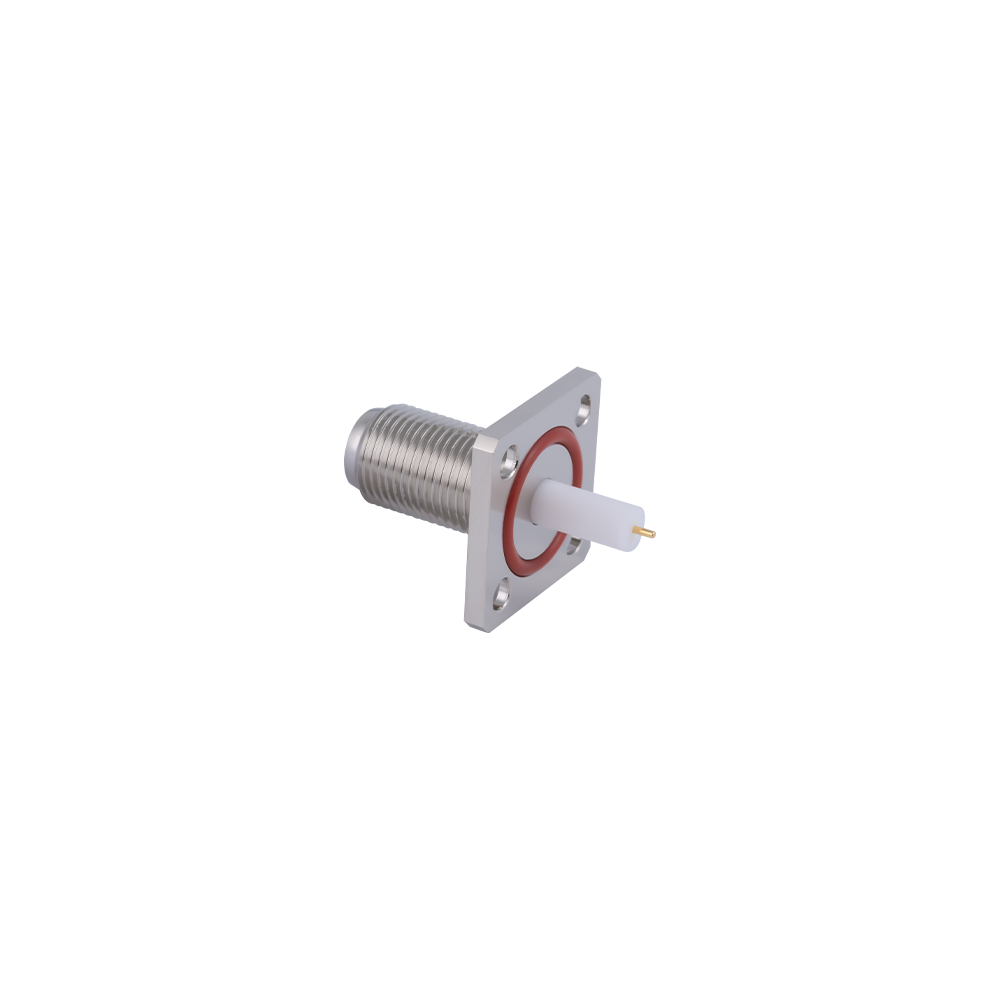
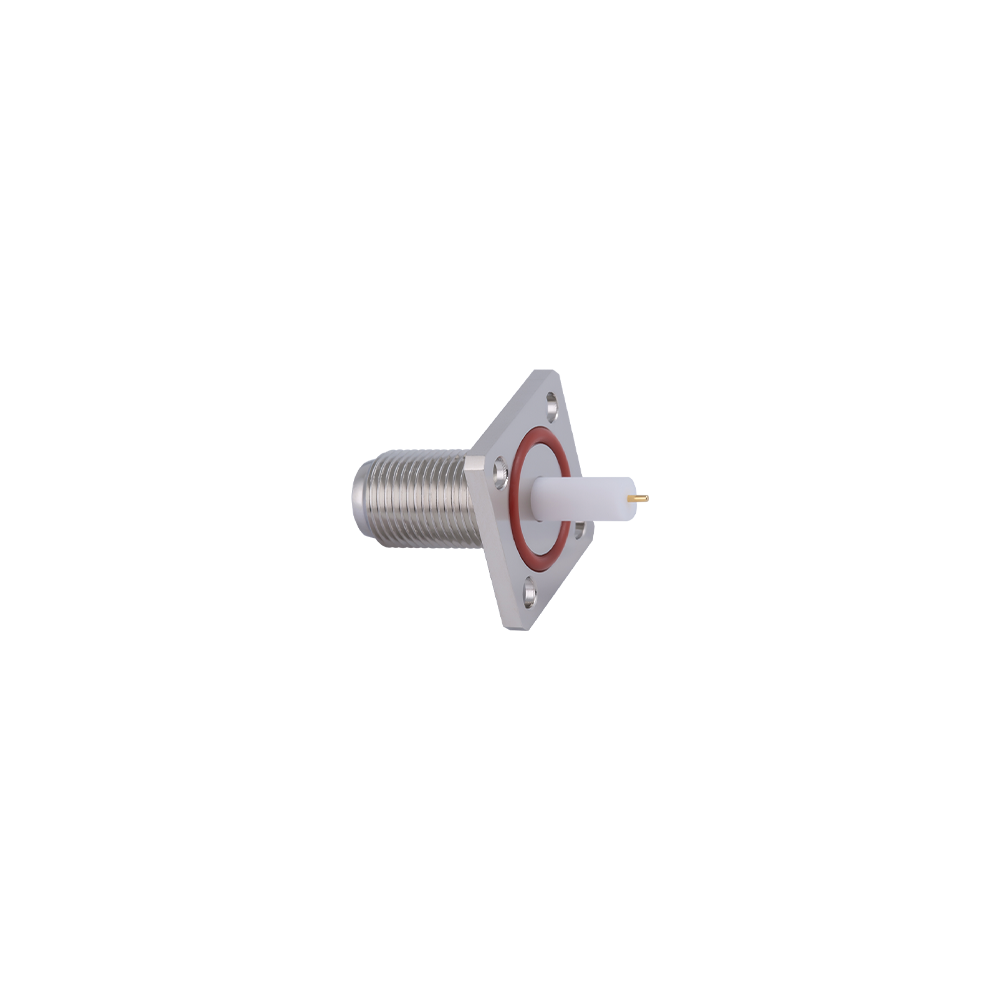
F micro-strip RF connectors are board-mount versions of the F connector interface, designed for direct soldering onto a printed circuit board rather than termination onto cable. The connector retains the threaded, screw-on coupling of the standard F interface, while the mounting end is formed with contact legs or a flange that seats onto the board pads and micro-strip transmission line.
Because the center contact is soldered directly to the board trace rather than relying on the cable core as the pin, F micro-strip RF connectors provide a repeatable board-level interface for equipment where an external cable must connect to an internal circuit at a fixed 75 Ω transition point.
Common Types and Characteristics
- Straight PCB mount connectors — mounted perpendicular to the board for panel-facing cable connections, commonly used at enclosure edges.
- Right-angle PCB mount connectors — mounted parallel to the board surface, used where enclosure height is limited.
- Edge-launch connectors — positioned at the board edge with the center contact aligned directly to the micro-strip line for a short, low-loss transition.
- Through-hole and surface-mount variants — selected according to board assembly process and required solder joint strength.
Core Performance Parameters
Typical electrical and mechanical specifications
| Parameter |
Typical Value |
| Impedance |
75 Ω |
| Frequency Range |
DC – 3 GHz |
| Coupling Type |
Threaded, screw-on |
| Mounting Style |
PCB through-hole or edge mount |
| Mating Cycles |
≥ 500 |
Typical Applications
The board-level interface of F micro-strip RF connectors is applied where consumer or broadband equipment needs a fixed connection point between an internal circuit board and an external coaxial cable.
- Set-top box and digital terrestrial (DVB-T) tuner circuit boards
- Cable modem and broadband gateway RF front-end modules
- Satellite receiver internal tuner boards
- Signal amplifier and splitter internal circuit assemblies
Comparison with Cable Mount F Connectors
Compared with crimp or compression F connectors used on cable, F micro-strip RF connectors terminate to a board trace instead of a cable core, which fixes the connector position permanently on the board and requires a soldering process rather than field crimping or compression tools.
Comparison of termination point, assembly method and typical use
| Connector Type |
Termination Point |
Assembly Method |
Typical Use |
| F micro-strip connector |
PCB pad and micro-strip line |
Soldering |
Internal board-to-cable transition |
| Crimp F connector |
Cable core and braid |
Crimping tool |
Indoor cable wiring |
| Compression F connector |
Cable core and jacket |
Compression tool |
Outdoor cable runs |
Selection Guide
- Choose a straight or right-angle body based on available enclosure height and board orientation.
- Match the contact leg spacing and footprint to the board layout to avoid trace rerouting.
- Select edge-launch designs where the shortest possible transition to the micro-strip line is required for higher-frequency signals.
- Confirm solder pad plating is compatible with the board assembly process, including reflow or hand soldering requirements.
- Verify panel cutout dimensions where the connector body must protrude through an enclosure wall.
Frequently Asked Questions
What does "micro-strip" mean for this connector series?
It refers to the connector's mounting method, where the center contact interfaces directly with a micro-strip transmission line etched on the printed circuit board.
Can F micro-strip RF connectors be reflow soldered?
Surface-mount variants are typically compatible with reflow processes, while through-hole variants are more commonly wave or hand soldered; the specific part datasheet should be checked.
Are these connectors compatible with standard F-type cable plugs?
Yes, the mating thread and center contact follow the same F interface, so standard cable-mounted F plugs mate directly with the board-mounted jack.
Manufacturing Background
Yangzhou Jingcheng Electronics Co., Ltd. produces F micro-strip RF connectors along with a broad range of RF connector series including SMA, BNC, TNC, N-type, and reverse polarity variants, together with high-frequency cable assemblies covering 0 to 50 GHz. Manufacturing follows ISO9001 quality management and MIL, IEC, and GB reference standards, supporting broadcast, broadband, and consumer electronics equipment.


 English
 中文简体
中文简体