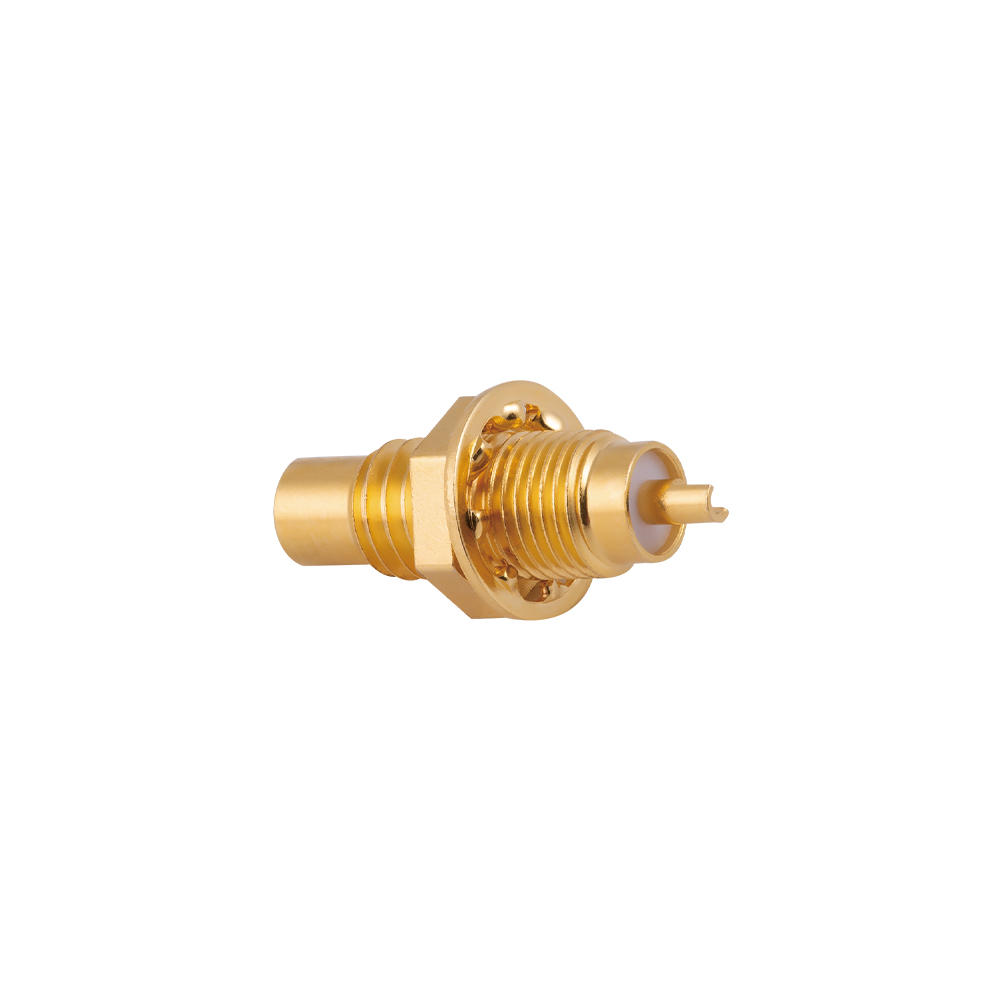
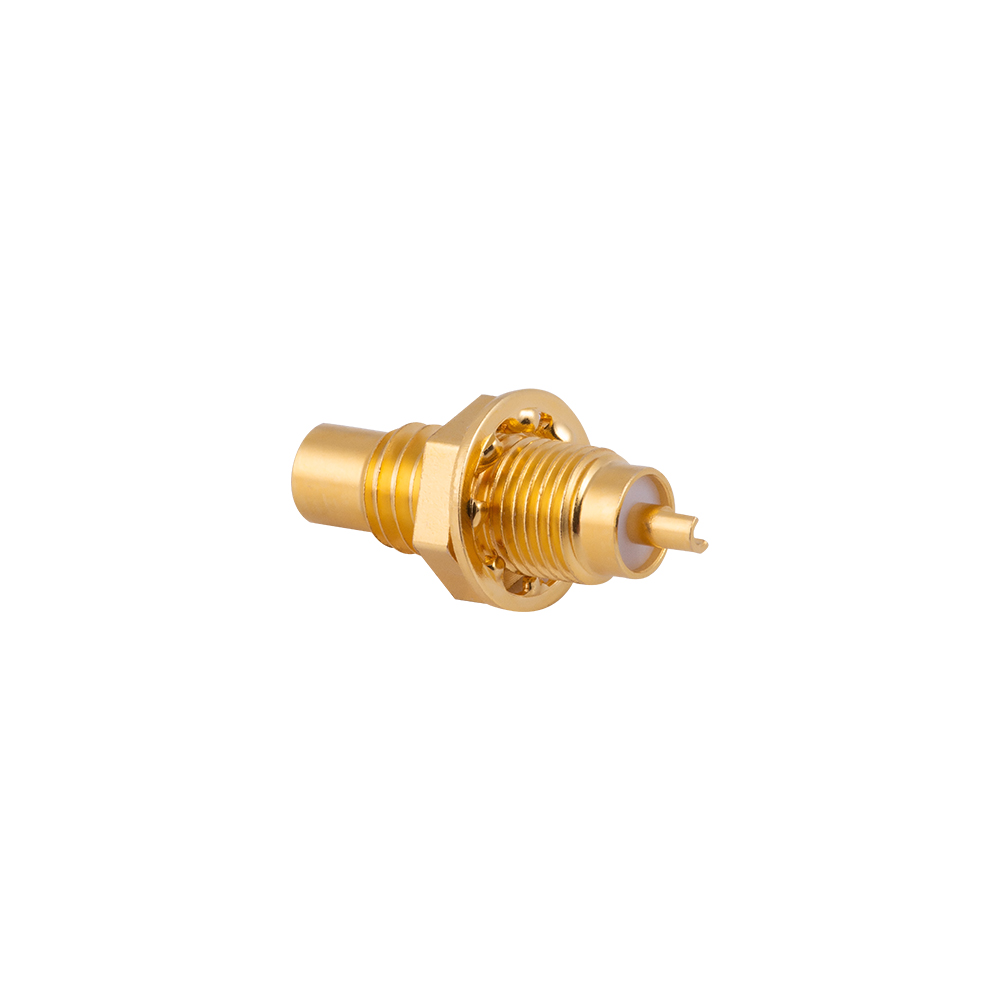
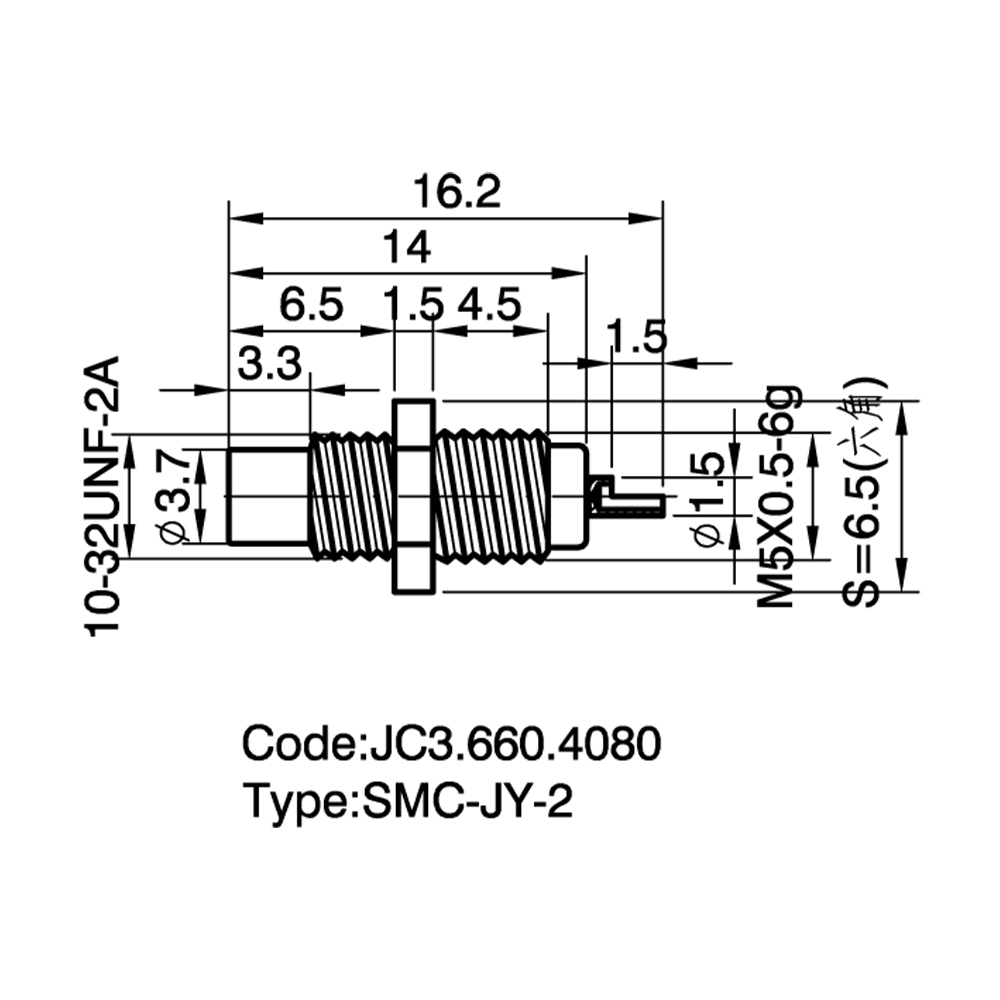
SMC Bulkhead Mount RF Coaxial Connectors Custom

Home / Products / Coaxial Connectors / SMC RF Coaxial Connectors / SMC Bulkhead Mount RF Coaxial Connectors

SMC Bulkhead Mount RF Coaxial Connectors Manufacturer

Product Introduction:
SMC series semi-flexible/semi-rigid cable connectors are designed for applications with stringent requirements on signal phase and transmission stability. This product is perfectly compatible with high-performance cables such as .086" and .047". With its precision-threaded coupling mechanism, it provides superior vibration resistance and anti-loosening performance compared to the SMB series in microwave systems.

Product Features:
Wideband and efficient: Supports a frequency range up to DC–6 GHz, with insertion loss as low as ≤ 0.24 dB.
High insulation performance: Insulation resistance up to ≥ 5000 MΩ, ensuring electrical reliability in harsh environments.
Precision manufacturing: Uses high-quality gold-plated brass housing and heat-treated beryllium copper center conductor, ensuring more than 500 stable mating cycles.

Application Advantages:
Resistance to extreme environments: The threaded coupling ensures stable signal transmission without fluctuation under severe vibration and shock, making it ideal for special communications and avionics equipment.
Ultra-low energy leakage: When used with semi-rigid cables with solid shielding, it achieves excellent electromagnetic compatibility (EMC).

Temperature  Range

-55~+155℃(PE Cable   -40~+85℃)

Impedance

50Ω

Frequency Range

DC~6GHz

Insulation resistance

≥5000MΩ

 Insertion loss

 ≤0.24 dB/6GHz

Voltage Standing Wave Ratio (VSWR)

 Straight ≤1.30/3GHz


 Right  angle ≤1.45/3GHz

 Durability(mating)

≥500 cycles

About
Yangzhou Jingcheng Electronics Co., Ltd.

Yangzhou Jingcheng Electronics Co., Ltd., a premier China SMC Bulkhead Mount RF Coaxial Connectors Manufacturer and SMC Bulkhead Mount RF Coaxial Connectors Supplier, was founded in 1999. It is a high-tech enterprise specializing in the R&D and manufacturing of RF coaxial connectors, cable assemblies, and passive microwave components.
Equipped with a comprehensive R&D and production system, the company has obtained international certifications including ISO9001. Adhering strictly to standards such as MIL, IEC and GB, we offer over 30 product series with more than 2,000 specifications, covering SMA, BNC, N-type and other mainstream models. Our products are widely applied in the fields of communications, aerospace, automotive electronics and beyond, and exported to many countries and regions across Europe, America and Asia.
We uphold the tenet of "Quality as the Foundation, Customers as the Core", committed to providing reliable interconnection solutions and professional services for global clients.

SMC Bulkhead Mount RF Coaxial Connectors Industry knowledge

SMC bulkhead mount RF coaxial connectors are threaded, panel-mounted interconnects used to pass an RF coaxial signal through an equipment wall or bracket while keeping the connection fixed, weatherproof-capable, and resistant to vibration. The SMC interface uses a 10-32 UNF threaded coupling nut, which gives the connector a secure mechanical lock that snap-fit interfaces such as SMB do not provide. Because the connector body is mounted directly into a panel or housing, SMC bulkhead mount RF coaxial connectors are specified whenever a cable assembly needs to cross a chassis boundary without an internal splice or an unsupported cable run.

Common Types and Construction Features

The category covers several bulkhead configurations built around the same 10-32 threaded interface, differentiated mainly by mounting method, gender, and sealing requirements.

Front-mount bulkhead jack

Panel-side hex or knurled nut with the connector body installed from the front of the panel; the mating interface sits flush with or slightly beyond the panel face.

Rear-mount bulkhead jack

Body inserted from behind the panel with the threaded boss protruding through the cutout, secured by a nut on the front face; used where the enclosure interior is accessible for assembly.

Two-hole flange bulkhead

Square or D-shaped flange with two mounting screw holes for connectors that need rotational lock against panel torque, common in test and measurement housings.

Bulkhead with captive O-ring

Adds a panel-face gasket to limit moisture and dust ingress at the mounting interface, used on outdoor or exposed enclosures.

Across these variants, contact and dielectric construction follows the standard SMC specification: a PTFE dielectric, brass or beryllium copper center contact, and a 50-ohm nominal impedance. Plating is typically gold over nickel on the contact and either gold or passivated finishes on the shell, selected based on contact-resistance and corrosion requirements in the installed environment.

Comparing SMC Bulkhead Mount Connectors With Related Bulkhead Interfaces

Bulkhead-style RF connector interfaces compared by coupling, size, and frequency range
Interface Coupling type Typical outer diameter Frequency range Mounting behavior
SMC bulkhead 10-32 UNF threaded nut ~6.5 mm across the nut DC to 10 GHz Threaded panel mount, front or rear
SMB bulkhead Snap-on ~6.5 mm across the shell DC to 4 GHz Push-fit panel mount, faster mating, no torque lock
SMA bulkhead 1/4-36 UNF threaded nut ~9.5 mm across the nut DC to 18 GHz Threaded panel mount, higher torque rating
BNC bulkhead Bayonet ~12.5 mm across the shell DC to 4 GHz Quarter-turn panel mount, quick disconnect

SMC bulkhead mount RF coaxial connectors occupy the space between SMB and SMA: the threaded nut gives a more secure lock than SMB's snap interface for installations subject to vibration, while the smaller body and lighter nut compared to SMA suit panels with limited space or a lower per-connector torque budget.

Application Scenarios

  • Test and measurement enclosures — panel feedthroughs on signal generators, spectrum analyzers, and calibration fixtures where the threaded lock prevents disconnection during repeated cable swaps.
  • Telecom and base station modules — chassis-to-cable transitions inside RF front-end units and repeater housings.
  • GPS, GNSS, and navigation equipment — compact enclosures where SMC's smaller footprint compared to SMA or N-type connectors is a mounting constraint.
  • Avionics and defense electronics — installations subject to shock and vibration, where a threaded bulkhead interface is specified over snap-on types.
  • Industrial control and instrumentation panels — RF signal routing across sealed or semi-sealed enclosure walls.

Selection Points

  • Panel cutout and mounting style. Confirm whether the application calls for a single round hole (front or rear mount) or a two-hole flange, and match the panel thickness to the connector's threaded boss length.
  • Gender and mating cable. Bulkhead jacks pair with SMC plugs on the cable assembly; confirm the mating connector on the existing cable before specifying.
  • Frequency range and VSWR. Standard SMC bulkhead mount RF coaxial connectors are rated to roughly 10 GHz; applications above that range should be reviewed against a higher-frequency interface such as SMA.
  • Environmental sealing. For outdoor, marine, or washdown environments, specify an O-ring sealed bulkhead variant rather than a standard dry-mount body.
  • Torque and vibration exposure. Where repeated connect/disconnect cycles or mechanical vibration are expected, the threaded SMC interface is preferred over snap-on alternatives such as SMB.
  • Plating and contact material. Gold-plated contacts are typically specified for low and stable contact resistance over the connector's service life; nickel or passivated shells are used where cost or specific corrosion resistance requirements apply.

Frequently Asked Questions

What distinguishes a bulkhead SMC connector from a standard cable-mount SMC connector?

A bulkhead connector includes a mounting nut, flange, or boss designed to pass through a panel and be fixed in place, while a cable-mount connector is terminated only to a cable and has no panel-fixing feature.

Can SMC bulkhead mount RF coaxial connectors be mixed with SMA cable assemblies?

No. SMC and SMA use different thread pitches and body dimensions, so the two interfaces do not mate directly. An SMA-to-SMC adapter is required if both interfaces need to be joined.

What panel thickness range fits a standard SMC bulkhead connector?

Standard SMC bulkhead bodies are typically produced for panel thicknesses in the 1 mm to 3 mm range; thicker panels require a bulkhead variant with an extended threaded boss, which should be confirmed against the specific part drawing.

Are SMC bulkhead connectors suitable for outdoor installations?

Standard bulkhead bodies are not sealed by default. For outdoor or exposed panels, a version with a captive O-ring at the panel interface is used to limit moisture and dust ingress.

What torque should be applied when mounting the panel nut?

Recommended mounting torque depends on the panel material and connector body; the value provided on the connector's datasheet or drawing should be followed to avoid over-tightening the threaded boss or under-sealing the O-ring, where present.

Yangzhou Jingcheng Electronics Co., Ltd. designs and manufactures SMC bulkhead mount RF coaxial connectors alongside the wider SMC, SMA, SMB, MCX, MMCX, BNC, TNC, N, and DIN series, with production supported by CNC machining and network-analyzer-based RF testing. Panel dimensions, thread length, sealing, and plating on this category can be adjusted to a customer's drawing in addition to the standard configurations listed above.