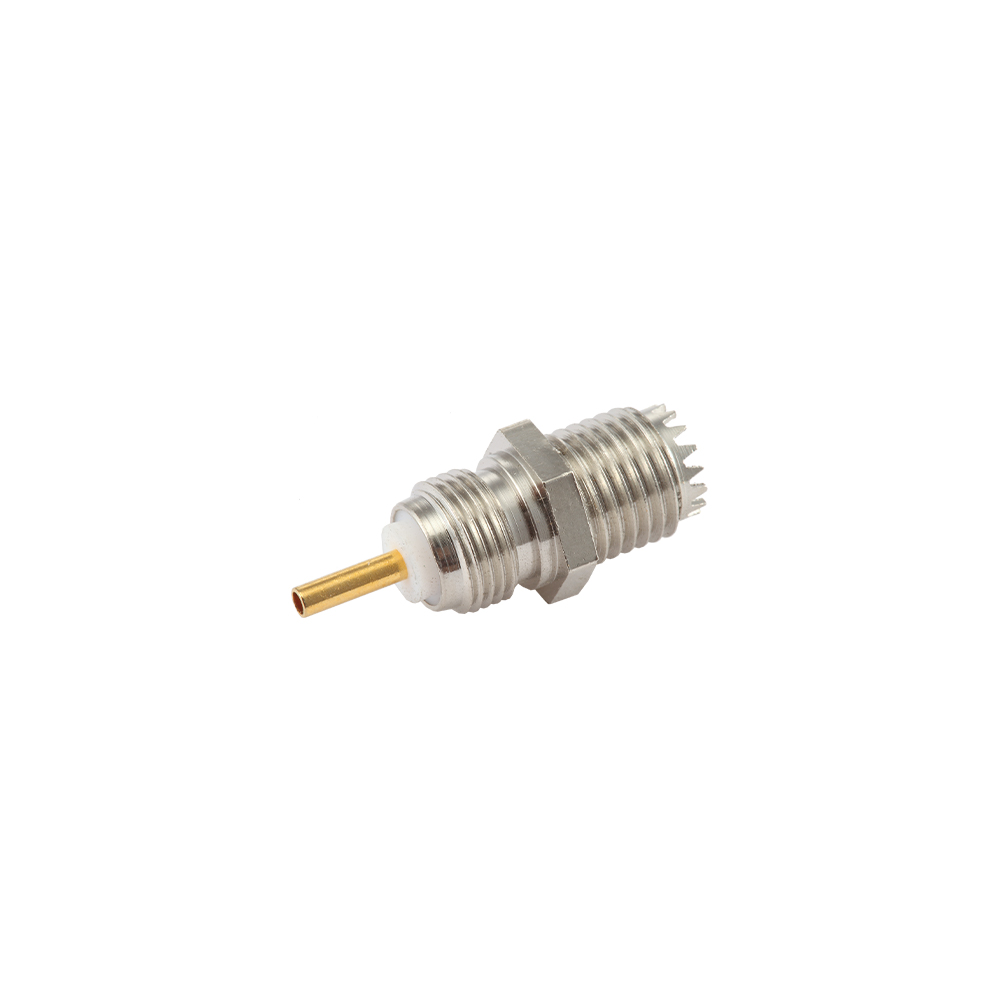
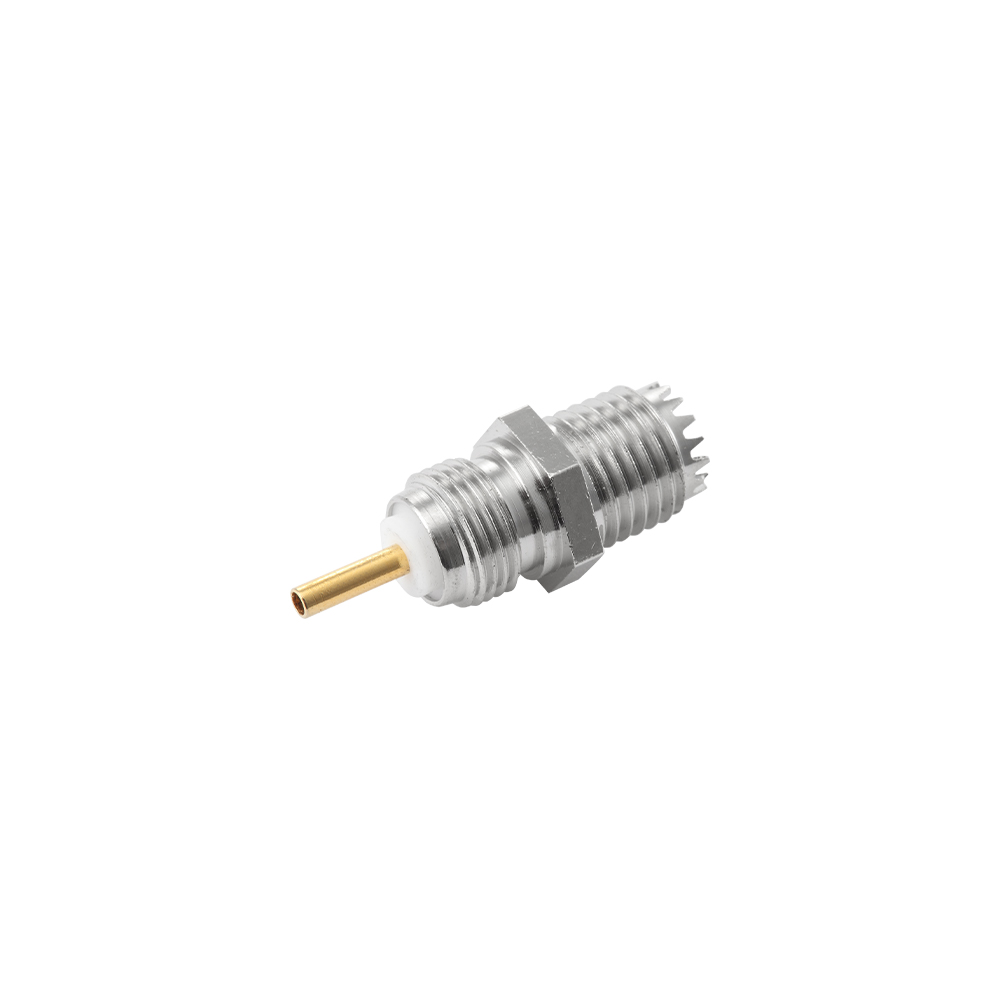
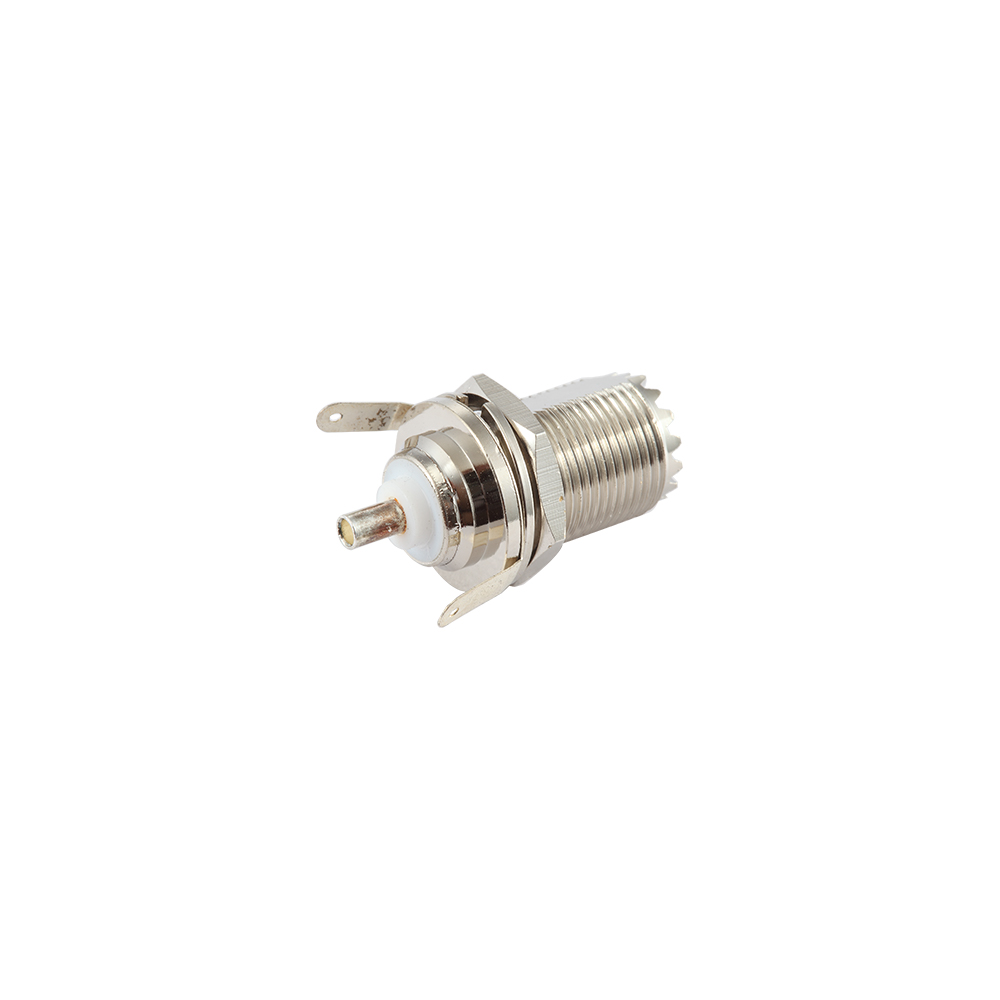
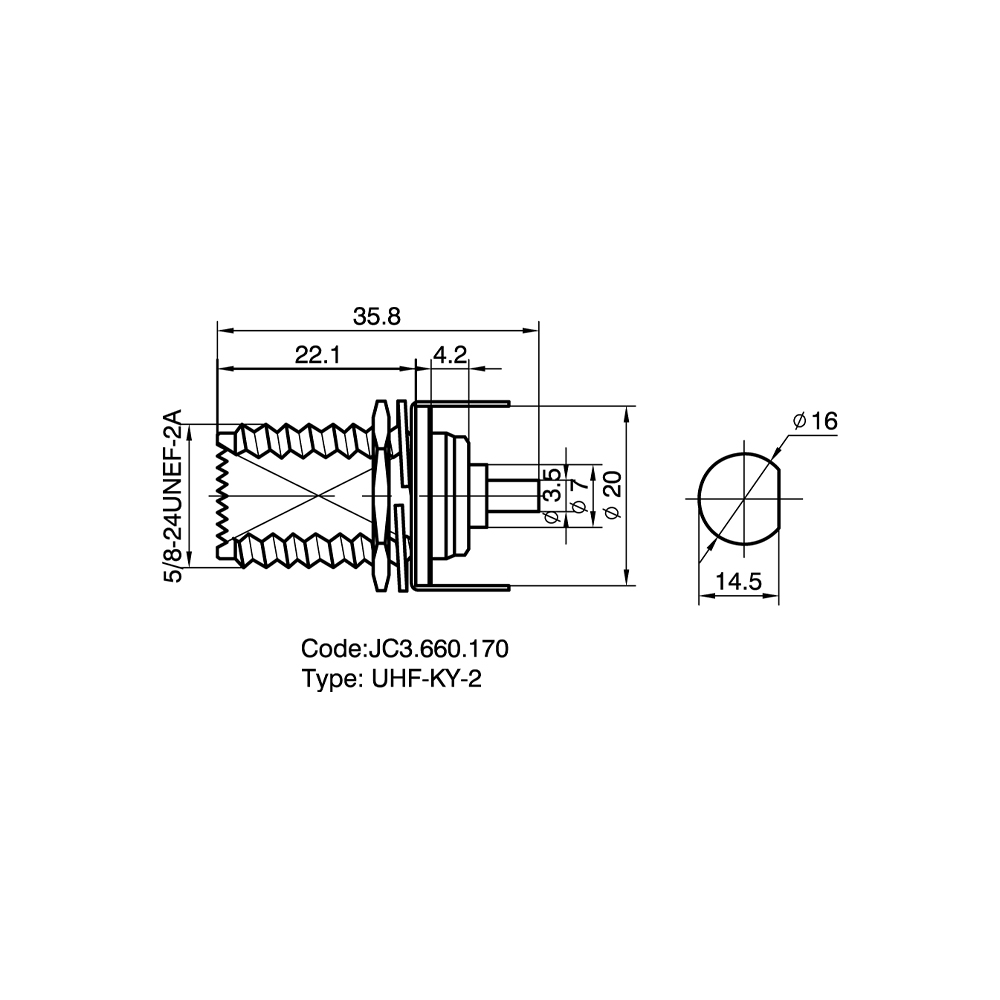
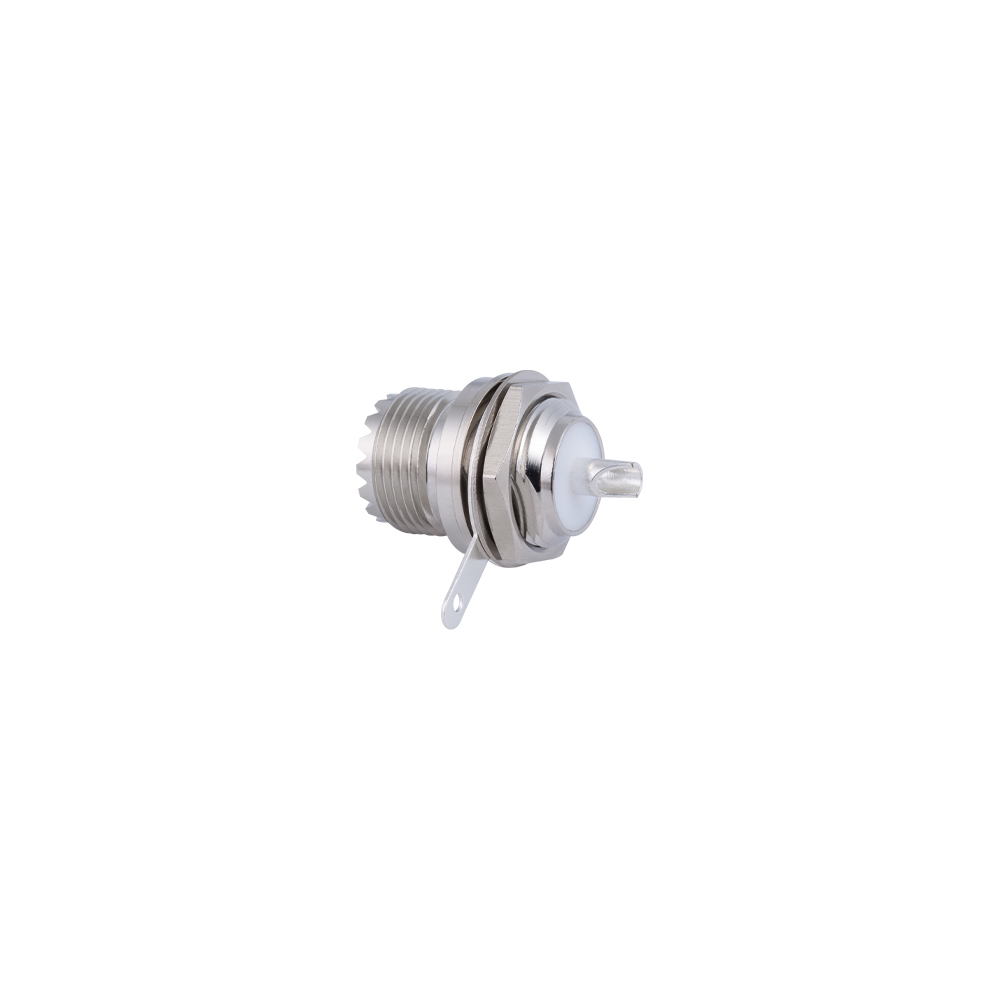
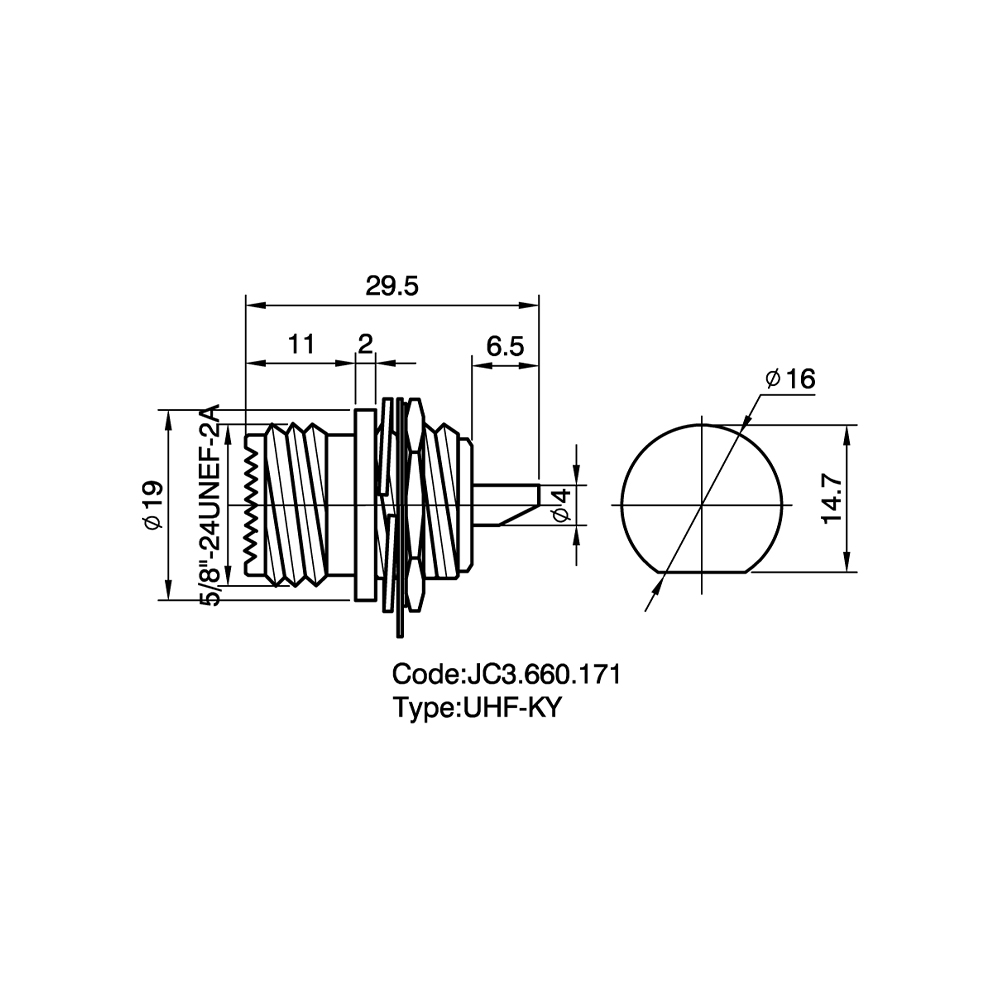
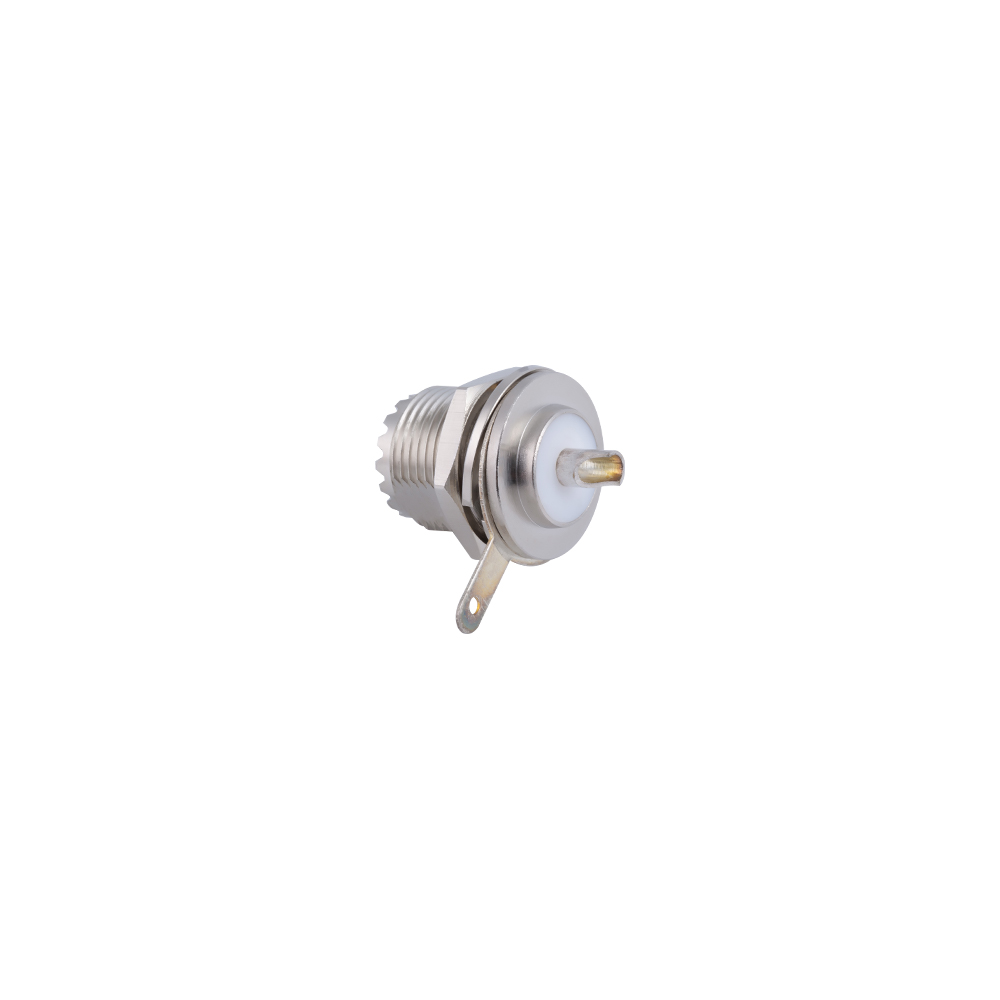
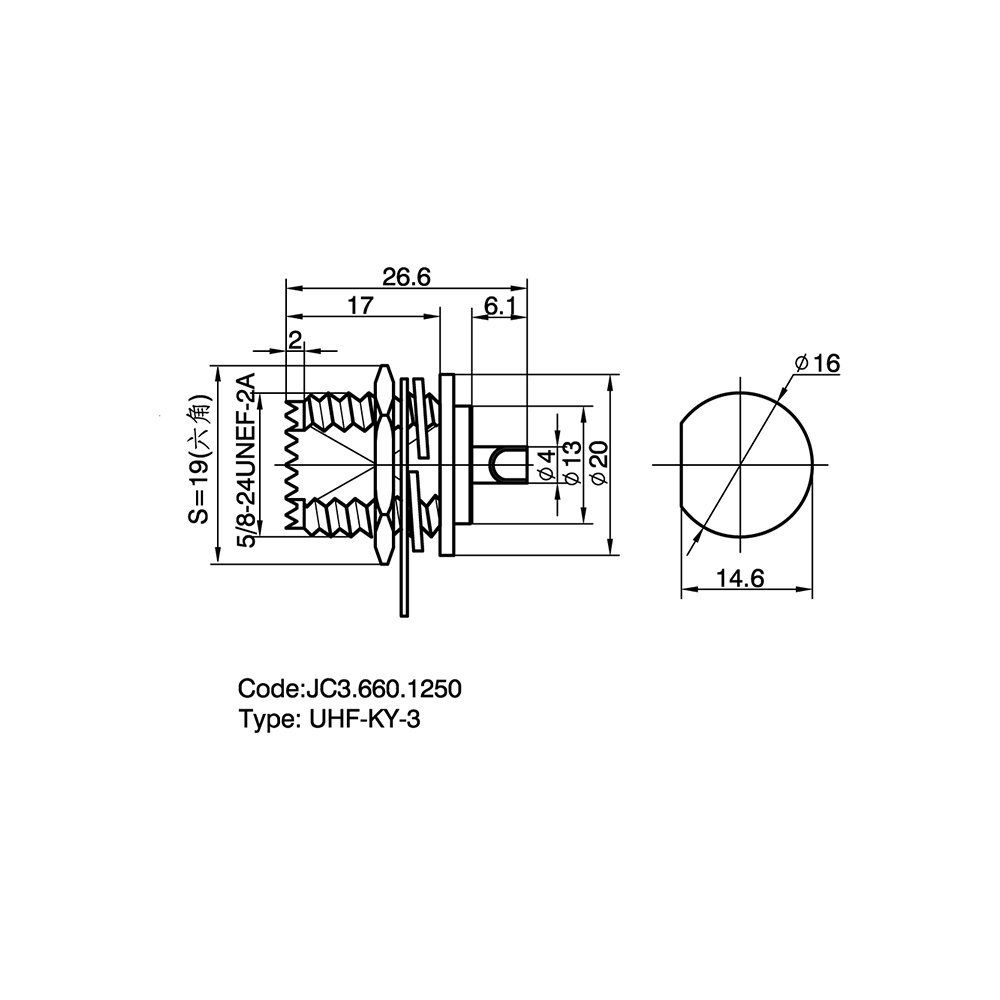
UHF bulkhead mount RF coaxial connectors are panel-mounted interconnection components used to route coaxial cable signals through an equipment enclosure, chassis, or panel wall while maintaining continuous RF continuity between the interior circuit and an external cable or antenna. The category covers UHF bulkhead jacks and UHF bulkhead plugs in single-hole and double-hole (flange) panel styles, produced with brass, nickel-plated brass, or silver-plated contact bodies and PTFE, Teflon, or PE dielectric materials.
Function and Working Principle
A UHF bulkhead connector operates on the same principle as a standard threaded coaxial connector: a center pin or socket carries the signal conductor, a surrounding metal shell carries the ground/shield reference, and a dielectric insulator separates the two while setting the characteristic impedance of the joint. What distinguishes a bulkhead type from an inline or cable-mount type is the mounting method — the connector body passes through a drilled panel hole and is secured on the inside of the enclosure with a locknut or mounting flange and screws, while the mating thread remains accessible on the outside face of the panel. This arrangement allows a sealed or grounded transition point between an internal PCB, transceiver, or amplifier circuit and an external antenna, cable, or radio feed line, without requiring the enclosure itself to be opened for cable routing.
Core Performance Characteristics
| Parameter |
Typical Value / Description |
| Frequency range |
DC to 300 MHz (some designs usable to 500 MHz with reduced performance) |
| Impedance |
Non-constant impedance, nominally treated as 50 Ω |
| Contact resistance |
Center contact ≤ 3 mΩ; outer contact ≤ 2 mΩ, depending on plating |
| Insulation resistance |
≥ 5000 MΩ |
| Dielectric withstanding voltage |
1000–1500 V RMS |
| Mounting torque |
Panel locknut typically tightened to 1.5–2.5 N·m |
| Body material |
Brass with nickel, silver, or gold plating |
| Dielectric material |
PTFE (Teflon) or polyethylene |
Product Highlights
- Screw-on (threaded) coupling, allowing mating and de-mating without special tools.
- Panel-through design supporting single-hole and flange (four-hole) mounting configurations.
- Compatibility with UHF cable-mount plugs (commonly designated PL-259) and jacks (SO-239), permitting mixed use with existing UHF-series cable assemblies.
- Suitable for RG-58, RG-8, RG-213, and similar coaxial cable diameters, depending on the crimp, solder, or clamp termination style selected.
- Available with O-ring or gasket options for panel-side moisture resistance in outdoor or mobile enclosures.
Variants and Detailed Comparison
Within the UHF bulkhead mount RF coaxial connectors category, several construction variants are produced to match different panel and cable requirements.
| Type |
Mounting Style |
Gender |
Typical Use |
| UHF bulkhead jack, single-hole |
Round hole with locknut |
Female |
Mobile radio chassis, marine radio panel feed-through |
| UHF bulkhead jack, flange mount |
Four-screw square flange |
Female |
Base station enclosures, fixed installation cabinets |
| UHF bulkhead plug |
Round hole with locknut |
Male |
Adapter panels, patch panels, test fixtures |
| UHF bulkhead with solder cup |
Round hole |
Male/Female |
Internal cable termination to PCB or coax jumper |
UHF Bulkhead vs. N-Type Bulkhead vs. BNC Bulkhead
| Connector Series |
Coupling |
Frequency Range |
Impedance |
Typical Application |
| UHF bulkhead mount |
Threaded |
DC–300 MHz |
Non-constant, ~50 Ω |
Amateur radio, CB radio, marine VHF |
| N-type bulkhead mount |
Threaded |
DC–11 GHz |
Constant 50 Ω |
Base stations, test instruments, microwave links |
| BNC bulkhead mount |
Quarter-turn bayonet |
DC–4 GHz |
Constant 50 Ω or 75 Ω |
Video/RF instrumentation, avionics, broadcast |
UHF bulkhead mount RF coaxial connectors use a non-constant impedance design and are generally limited to lower-frequency applications. Where frequency stability above several hundred MHz or precise impedance matching is required, N-type or BNC bulkhead connectors are typically specified instead.
Application Cases
- Mobile and amateur radio: UHF bulkhead jacks are mounted on transceiver rear panels to provide a fixed antenna feed point, mating directly with PL-259 cable plugs from the antenna feed line.
- Marine communication equipment: Flange-mount UHF bulkhead connectors are installed on sealed enclosures for VHF marine radios, with a gasket at the panel interface to limit moisture ingress.
- Test and patch panels: UHF bulkhead plugs and jacks are arranged on patch panels to allow quick reconfiguration of signal paths in a lab or workshop setting.
- CB radio and PA systems: Solder-cup bulkhead versions connect internal amplifier boards to an external antenna jack on the equipment housing.
Installation and Maintenance Guidance
- Drill the panel hole to the diameter specified in the connector's mechanical drawing; an oversized hole reduces grounding contact at the mounting flange.
- Tighten the panel locknut to the manufacturer's recommended torque; overtightening can deform the dielectric insulator and shift impedance.
- When soldering the center pin, avoid prolonged heat exposure, which can damage the PTFE or PE dielectric and alter electrical performance.
- Inspect the mating thread and center contact periodically for corrosion or oxidation, particularly in outdoor or marine installations; clean with a dry cloth or contact cleaner rated for RF connectors.
- Check the panel-side gasket or O-ring condition during scheduled maintenance on outdoor enclosures, and replace if cracked or compressed.
- Store spare connectors in sealed packaging to prevent contact oxidation prior to installation.
Frequently Asked Questions
What is the difference between a UHF bulkhead jack and a UHF bulkhead plug?
A UHF bulkhead jack has a female center contact and mates with a male cable plug (commonly PL-259 style); a UHF bulkhead plug has a male center contact and mates with a female cable jack (commonly SO-239 style).
Can UHF bulkhead mount RF coaxial connectors be used above 300 MHz?
They can be operated at higher frequencies, but the non-constant impedance design results in increased signal loss and VSWR compared with constant-impedance connectors such as N-type or BNC bulkhead versions.
Which cable types are compatible with UHF bulkhead connectors?
Common pairings include RG-58, RG-8, and RG-213 coaxial cables, selected according to the connector's center pin bore diameter and cable clamp or crimp specification.
Are single-hole and flange-mount versions interchangeable?
They are not directly interchangeable, since the panel cutout dimensions differ. Single-hole versions require a round drilled hole, while flange versions require a square cutout with four mounting screw holes.
Do UHF bulkhead connectors require weatherproofing for outdoor use?
Standard UHF bulkhead connectors do not include integral sealing. For outdoor or marine panels, a gasket or O-ring at the panel interface, together with a weatherproof boot at the mating joint, is used to limit moisture ingress.
Yangzhou Jingcheng Electronics Co., Ltd. (JC Company), founded in 1999, manufactures UHF bulkhead mount RF coaxial connectors together with related SMA, N-type, BNC, and TNC connector series, cable assemblies, and passive RF components under ISO9001 quality management, with production referencing MIL, IEC, and GB standards for communication, marine, and mobile radio applications.


 English
 中文简体
中文简体